How to buy the book

You can order at History Press as well as Amazon, Barnes and Noble and other on-line retailers. I will send you a signed copy for $23, a little extra to cover shipping. I will send you both Slave Labor in the Capital and Through a Fiery Trial for $40. Send a check to me at PO Box 63, Wellesley Island, NY 13640-0063.

My lectures at Sotterley Plantation in St. Mary's County, Maryland, on September 23, 2015, and the DAR Library on December 5 are now blog posts below listed under book talks. The talk I gave
at the Politics and Prose Bookstore on February 28, 2015, along with Heather Butts, author African American Medicine in Washington, was taped by the bookstore. Take a listen.
Showing posts with label White House. Show all posts

Monday, February 29, 2016

Commissioner Thornton's "two or three common laborers"

Evidently none of Smallwood’s hires could be spared to clean up the White House grounds. Commissioner Thornton offered to throw himself into the breach. "I have offered to do all in my power in laying out a garden and other conveniences,” he wrote to Stoddert, “if my colleagues will only allow me two or three common laborers....." 
Quote from Slave Labor in the Capital, page 156


Thursday, December 3, 2015

Foundations: positioning the "Palace"

Washington wrote a letter to his personal secretary back in Philadelphia that on his return, Hoban would "enter heartily upon the work," and he had already "laid out the foundation which is now digging." The president didn't mention the diggers. It was as if the foundation was digging itself.

Quote from Slave Labor in the Capital, page 59-60

What I quoted in the book came from a letter Washington wrote to Tobias Lear on July 30, 1792, see the letter. After I wrote the book I found a photocopy of a letter Commissioners Stuart and Carroll wrote to Commissioner Johnson describing Washington at the site of the "Palace."

He viewed the ground "particularly at the place for the Palace. It has given him considerable difficulty trouble and difficulty to fix his mind...." I am not sure I would have used that in the book in order to make more fun of Washington not saying who was digging the foundation. The larger significance of Washington's "trouble and difficulty" is that this was his first time touring the site since L'Enfant left. Was Washington's mind too brittle to grasp the complexities that L'Enfant made seem easy?

The commissioners also discuss their need for brick makers in the letter.


Sunday, November 15, 2015

Incipient racism: Williamson's letters to Presidents Washington and Adams

 In 1794 after the commissioners fired Collen Williamson who they had hired to superintend the stone work at the White House, he tried to get his job back, even suing the commissioners for what we would call today "age discrimination." He was 65 when he was fired. In the two letters below written in 1797 he wrote to Presidents Washington, who left office in March, and Adams, arguing that he could have saved thousands of dollars for the government if he had not been fired.

I copied his letters because he often boasted of his accomplishments and denigrated James Hoban who he blamed for his dismissal. Hoban hired the man, McDermott Roe, who hired the Irish stone masons who replaced the men, mostly Scots, that Williamson had hired. Those Irish masons did the poor work which led to walls collapsing at the Capitol.

In the letter to Washington he mentions the "negro's" who attended the 30 Irish masons.


In his  November 1797letter Williamson rather expanded his attack on Hoban and this time rather than just mentioning the slaves, he denigrates them as not equal to white workers. " They likewise have among them ten or twelve negro apprentices and drawing wages for them six of them is not equale to one good hand."

Here is my transcription of  first part of the letter.
City of Washington, November 27, 1797 Honorable Sir, I should not have troubled you in writing but considering myself still in the public employ, I think it my duty to give information of what has been going on here for too long a time. There is a James Hoban, an Irish carpenter engaged as arcteck for the President's house from Charleston and soon after came acompany of thives his former associats being three in number. those men most all of them he putt in places of trust, one is made overseer of the carpenters and charge of all the lumber at the presidents house, the second foreman of the carpenters at the capitole, the third store keeper of the repository where all the white lead and oil paints nails spads and c are stored for the use of the work, the above trusties have built for themselves five or six houses mostly out of public materials which proof is as follows, and has been proven the painter stored ninety four gallons of oile, at ten shillings per gallon, out of which they stole seventy nine, the public got onlt fifteen gallons of their own oile, the painter reported to your nominal commissioners and then an investigation was mead, the oile and lumber proven I have it to the judgment of others how much the other materials has disappered, by being under such hands, they likewise have among them ten or twelve negro apprentices and drawing wages for them six of them is not equale to one good hand, the gentlemen here says it was good policy in Hoban to get me putt out of place fore then there was non to restrain them, they did as they pleasd, this man have been a recepticle for all the Irish vagbons that came in his way, there is noting here but fighting lying and stealing and will be as long as this man is in power...
Other than Williamson age and frustration, a change in the commissioners' attitude toward Hoban might account for the petty viciousness and racism of Williamson's attack. As they ran out of money the commissioners paid more credence to complaints about Hoban's management style as he superintended the construction at White House. He had full command of the facts and was the only man who give the commissioners the information they needed to persuade congress to rescue the project. But Hoban also rewarded cronies and by hiring his own slaves as carpenters or apprentice carpenters managed to make more money than a commissioner.

In an effort to clip Hoban's wings, the commissioners required better supervision of building materials and banned the hire of slave carpenters. Did the commissioners' disciplining Hoban embolden Williamson to impugn the slaves which he had refrained from doing in his earlier letters? Perhaps that, and an expectation that John Adams, a northerner, would respond to his impugning slaves.

Neither president answered Williamson letters. They were forwarded to the commissioners who ignored his letters.


Wednesday, January 7, 2015

Hoban's estimates of expenses and use of phrase "Negro carpenters"

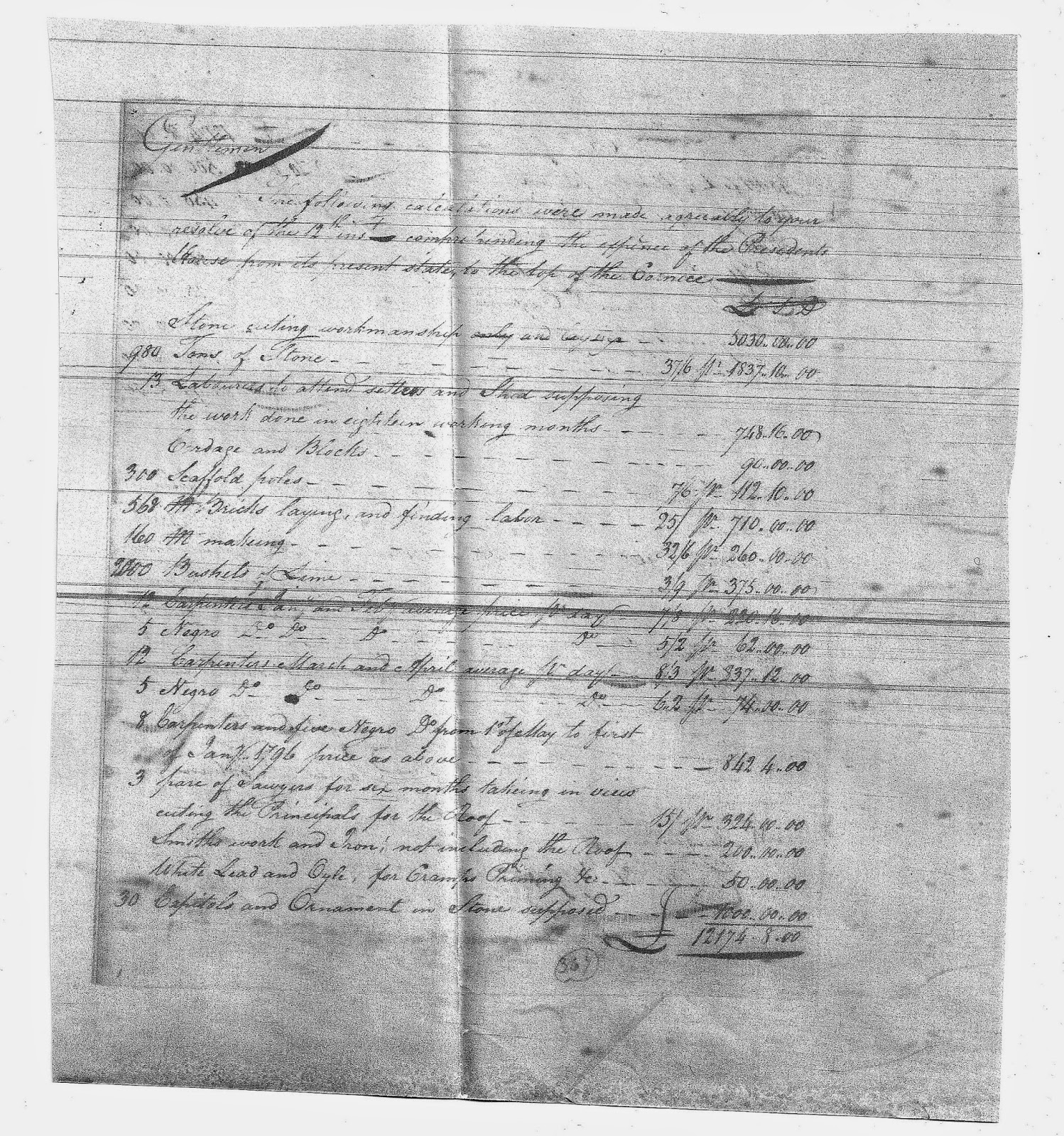
In 1796, when Hoban made a list of workers needed to finish the White House, he listed "Negro carpenters..."

Quote from Slave Labor in the Capitol, page 107

I found two "estimates" written by James Hoban, judging by the hand writing, that both project the use of hired slaves. While it is important to note estimates, we can't assume that those estimates came to pass, especially in regards to slave hire. Both the documents below are long, and both the reduced and original size versions are difficult to read. Circa 1989 the photocopy machines in the Library of Congress were worse than most and all were bad.

The second, and longer, document scanned below estimates the cost "for the hire of 100 Negros" at 22/10/0 a year for each, or, by my calculations, $59.85 a year. The next line estimates the cost of their daily subsistence at 12 pence a day. That meant the annual estimate for slave hire 2250 Pounds was not that much higher than the annual subsistence of 1875 Pounds.

What I also find notable in the second estimate is that the listing of hired slaves comes after the estimate of stone deliveries. In late 1794, slave use in Hoban's mind may have been tied closely to getting the stone from the wharves to the buildings and then up onto the walls. What is also notable is that there is no mention of the monthly hire of slave or free laborers. We know that laborers were hired by the month because they are listed as "monthly hires" in December 1794 payrolls.

I think that by listing the hire of 100 slaves at so cheap a rate, Hoban was making just the kind of hopeful simplification of the work ahead that the commissioners wanted. There would be a large number of tractable and cheap laborers on hand. Actually getting them was another matter. I think I have evidence that when the commissioners wanted to hire 120 slaves in 1798, they hired 90. So I think a rough estimate that 1/4 of the laborers were free (including some free blacks) is a good one.

In the rest of the second document (which consists of two scans sine I had to cut my photocopy of the original in two to get in onto my scanner,) there is no mention of "Negros" when mention is made of stonecutters, or mention of carpentry, sawying, brick laying, etc.

I think the first document the more important one. In it Hoban estimates how much it would cost to raise the White House from its "present state to the top of the cornices." Hoban estimates 13 "laborers" needed to attend the stone setters and "shed." The stone cutters worked in the shed. So here I think he is accepting the reality that some laborers were free. He didn't call them Negroes.

In the rest of the document he does use the word Negro and describes the reality of the work crew as the payrolls from early 1795 show: below the 12 carpenter he lists, he lists 5 Negro carpenters. Those were the slaves he and his foreman at the White House owned. By segregating them he can show that they cost about two shilling less, about 25% less, than free carpenters. Was he presenting an argument for the hire of slave carpenters? If so it fell on deaf ears because in November 1797, the commissioners banned the hire of slave carpenters.

Finally, when he estimated the wages of sawyers, he didn't note "Negro" sawyers even though he had advertised for them and by August 1795 would exclusively use them. This supports the suggestion I make in my book that Hoban came up with the idea of extra wages for hired slaves to do sawing in August. In January he estimated that each pair of sawyers would be paid 15 shillings a day. As it turned out when he started using slave sawyers it cost  him 2 shillings, 25 cents, in extra wages a day for a pair plus the $60 a year or 22 Pounds paid to the master for each slave. He saved a good deal of money by using the hired slaves as sawyers. This suggests that prior to using slaves, he always paid free laborers or used contractors. The free sawyers could have been free blacks and the contractors likely used slaves.


You can get the context for the report in Through a Fiery Trail, chapter 36. Taking a closer look at the document, I realize now that I misdated it in Slave Labor in the Capital. But the point remains. The document shows that Hoban thought of slave carpenters as an integral part of his crew and the commissioners knew it.