How to buy the book

You can order at History Press as well as Amazon, Barnes and Noble and other on-line retailers. I will send you a signed copy for $23, a little extra to cover shipping. I will send you both Slave Labor in the Capital and Through a Fiery Trial for $40. Send a check to me at PO Box 63, Wellesley Island, NY 13640-0063.

My lectures at Sotterley Plantation in St. Mary's County, Maryland, on September 23, 2015, and the DAR Library on December 5 are now blog posts below listed under book talks. The talk I gave
at the Politics and Prose Bookstore on February 28, 2015, along with Heather Butts, author African American Medicine in Washington, was taped by the bookstore. Take a listen.
Showing posts with label laborers. Show all posts

Thursday, March 3, 2016

Tunnicliff's diary.

The Englishman William Tunnicliff and his wife managed a hotel for the Philadelphia speculator John Nicholson. They hoped to make their establishment on 6th near Pennsylvania Ave SE the center of Capitol Hill life. Tunnicliff's ambitious plans were premised on a steady flow of cash and credit from Nicholson. Like Lewis Deblois, William Prentiss and William Lovering, Tunnicliff wrote frequently to Nicholson begging for money, usually in vain.

Tunnicliff had the brilliant idea to send Nicholson what he called portions of his diary that noted every instance of his lacking money to carry on his and Nicholson's business. In these diary entries that are in Nicholson's papers, I did not find the word "slave" or "black." That is not surprising. White people in the 1790s rarely wrote about slaves and blacks in general or as a part of the community.

In 1797 upwards of 90 hired slaves worked on the Capitol and White House. Most of them lived in a log hut camp on Capitol Hill. But they were not a part of Tunnicliff's world. Judging from his diary, he owned two slaves. The diary mentions "our boy Sandy" ordered about by his wife, and "my man Tom."

As the diary shows Tunnicliff was overseeing construction which entailed hiring laborers. Since he paid those men directly for their day's work, they were not slaves. There is no mention of their having masters. Only commissioners had the financial resources to hire a large number of slaves. Nicholson did not give Tunnicliff enough money to finance his operations let alone allow him to hire slaves. As the diary shows, providing bread to workers substituted for actually paying them.

The preferred way to always have someone around who would do the menial tasks that always popped up in a rather inconvenient city was to buy a slave who would do the work and who could be sold when, as I assumed happened in Tunnicliff's case, his Washington dreams ended and he moved north.

In time slave hire in the city would become more sophisticated. Some slaves would hired themselves out. But in 1797 whites like Tunnicliff, Deblois and Lovering who tried to establish themselves in the city bought slaves as servants and to do odd jobs.

(You can find larger images of the letters at the end of the post.)


Monday, February 29, 2016

Commissioner Thornton's "two or three common laborers"

Evidently none of Smallwood’s hires could be spared to clean up the White House grounds. Commissioner Thornton offered to throw himself into the breach. "I have offered to do all in my power in laying out a garden and other conveniences,” he wrote to Stoddert, “if my colleagues will only allow me two or three common laborers....." 
Quote from Slave Labor in the Capital, page 156


Saturday, January 2, 2016

Assessment of Improved Property in 1803

"At the end of the month 7 free workers were hired, including Ambrose Moriarty.
In 1799 Moriarty wrote a letter to the commissioners saying he wanted to buy a building lot. He introduced himself by saying "I have formerly been employed in attending masons and other work for the public." He did buy a lot and was on the city’s 1803 tax roll."
Quote from Slave Labor in the Capital, page 97

In 1803 Moriarty owned an improved lot on Square 432 assessed for $1000. He obviously didn't rely entirely on his wages as a laborer to accomplish that. I don't know where I found this list back in 1990, or who compiled it. What is also interesting in the context of my book on the use of slaves is how few masters who hired out slaves are on the list. Most of those few on the list were also contractors or employees doing work for the commissioners like Samuel Smallwood and Bennett Fenwick.

The exception was Ignatius Boone who owned property in square 907 valued at $1100 hired out at least 4 slaves, Charles, Jacob, Lewis and Moses. My guess is that he moved to the city after he hired out the slaves, not while he did.


Tuesday, December 22, 2015

Fixing the wharf crane: the very short stories told by receipts

A cart was sent all the way to Commissioner Johnson’s iron-works in Western Maryland to bring iron castings for the crane at the wharf where stone for the Capitol was unloaded.
Quote from Slave Labor in the Capitol, page 83

Building a narrative of the work done based on accounting receipts is more akin to archaeology than history. One would prefer a letter explaining the problem and the solution. Why did the crane need the castings? was it busted and for how long? how big was the crane and was it all made of iron?

A 1794 receipt for a hauling contractors tells three stories in as few words as possible: hauling plank from Funks Town, hauling stone from "Greenleaf's buildings" and hauling the iron castings for the crane at the Eastern Branch wharf.

We can't prove that slaves did any of this work but we can easily picture hired slaves unloading and loading the carts. Thomas Johnson owned slaves so probably the slaves at the iron-works loaded the castings that they probably had a hand in making.                                                                                              


Monday, December 21, 2015

The quest for indentured workers


When they looked to Europe for workers, the president and the commissioners yearned for stonecutters because "the few here have us under command as to terms."

Actually the quote I used in the book was “could command their price.” The quote above comes from the October 1794 letter from the commissioners to James Greenleaf that I scanned below. I didn't use it in the book because it gives the impression that there was a dire shortage of stone cutters. Here is a payroll from December 1794. http://archivepayrolls.blogspot.com/2014/12/payroll-for-stonecutter-december-1794.html  

There were plenty of stone cutters. The importance of the letter is not as a description of reality but as a projection of the commissioners' idea of the best of all worlds. Beginning in 1792 http://founders.archives.gov/?q=Correspondent%3A%22Commissioners%20for%20the%20District%20of%20Columbia%22%20Correspondent%3A%22Washington%2C%20George%22&s=1111311111&r=26and not petering out  until 1796, the urge to get indentured workers from Europe was sung with many refrains. This is how it went in the letter to Greenleaf:
...You know the state of our funds and how necessary it is to make the most vigorous exertions in the course of next year.... The work before us and the period in which it is to be done urge us at this moment to enter into very extensive contracts if the state of our funds permitted, among others we deem it indispensable to procure a number of Stone Cutters. They are not to be had in this country. The few here have us under command as to terms -
How did the yearning for indentured workers relate to slave hire? It wasn't racism because there were no African American stone cutters available. The commissioners' yearning exposed their fear of free workers. Indentured workers were not slaves but in order to get passage to the New World they signed away their freedom for a limited term.

While planning monumental buildings for the ages, President Washington and the commissioners thought in the short term when it came to hiring the men to build it. The money they paid for indentured servants went to sea captains, just as the wages for hired slaves went to their usually faraway masters. Wages paid to free workers generally stayed in the area.  But far more important than building a local economy was checking the demands of free laborers. That is how the commissioners justified slave hire in 1792. In the 1794 letter below they put it this way:

- We see no means so likely to check the exorbitant prices of building as the arrival of a number of Tradesmen and Labourers at the City of Washington and this check will be more effectual if a proportion of them are under terms of service for a time part to yourself and others to the Commissioners....
Ironically, this mean approach continued even as the commissioners thought the investments of James Greenleaf guaranteed financing of the city until 1800. He was going to Europe to get a loan to support his own operations and the commissioners'.  The commissioners were giving him advice, if not a warning, to join them in their check-the-demands-of-labor policy. In that regard, Greenleaf operated on the opposite principle and made generous contracts with workers and his salaried employers. See  http://capitalslaves.blogspot.com/2015/12/the-dazzling-greatness-of-james.htm

As it turned out, Greenleaf didn't get a loan and soon went bankrupt. No indentured workers were hired on the commissioners' account. Here is my transcription of other parts of the letter and, below the scans of letter discussed in this post, there is another letter to Greenleaf of the same date somewhat thinking out loud about indentured stone cutters: http://capitalslaves.blogspot.com/2015/12/gardens-for-workers.html

we therefore request you will on your arrival in Europe pursue immediately such measures as will most probably insure the obtaining of a number of men who have been bred to cutting and laying free stone, among them there should be some who have been in the practice of stone carving in the same line....
We will engage to pay not exceeding thirty Guineas per annum (we think L20 Sterling high) and for maintenance (clothing excepted) for as many years as you can obtain them for, not exceeding four years and not under two at least. We agree that you should pay their passage to the City of Washington on account of the Commissioners, they allowing 1/3 of their passage money to be deducted out of their Wages annually for three years or 1/2 for two years. It will be necessary that the terms and obligations should be fixed with precision so as to leave no difficulties on their arrival.


With respect to the Stone Carvers there is such a difference both in execution and taste, that it may be necessary to leave this to the chance of your procuring them to come over on their own risk with regard to the price for their service, but on a certainty of being very liberal according to their respective merits - from 3 to 6 at least of such persons will be necessary, we mean such as would be qualified to take each of them in charge a number of Stone Carvers & cutters. Some of them should be capable of cutting Capitals of the higher order.
We would extend our views further if not constrained by considerations already mentioned, and desire you to have procured a number of suitable tradesmen and labourers on the best terms you can, but fear this must depend on the success of the Loan - if favorable you will do so in this as you will for yourself


Monday, December 14, 2015

Irishmen did the bulk of the digging, not slaves

"His major work for the commissioners was digging a canal or at least 27,000 cubic yards of it that widened and deepened James Creek, a small stream south of the Capitol. That was enough digging to make a hole largest enough to swallow the entire White House. He only used 15 hands. The commissioners and the President, whose pet idea it was, lost interest in the canal when they realized how much it would cost. In the summer of 1793, the commissioners paid Whelan at least $860 for digging the foundation for the Capitol."
Quote from Slave Labor in the Capital, pages 60 & 61

The document below is a photocopy of a page of the commissioners' proceedings in September 1792 that discusses digging a canal to connect St. James Creek south of the Capitol with Tiber or Goose Creek that flowed west of the Capitol. The commissioners began using slave labor that summer, but, as the document shows they made a contract with Patrick Whalen or Whelan.

There is rarely any list of the workers used by a contractor but Irish laborers were commonly used to make the canals around the falls of the Potomac. There is evidence that Whalen himself owned a slave named Bill Scotland, and certainly many Irish workers bought slaves once they had the money to do so. However, I think it best to assume that Whalen used his countrymen in 1792. There is no evidence that he ever hired out slaves to the commissioners which other contractors who had slaves did do.


Thursday, December 3, 2015

Proof that L'Enfant did not hire slaves

"He didn't hire any slaves."
Quote from Slave Labor in the Capital, page 38

In September 1791 the commissioners authorize L'Enfant and Ellicott to hire 150 laborers. They managed to hired 75. There is no evidence that any of them were hired slaves. After those laborers were fired, the commissioners resolved to hire slave laborers. They would not make such a pointed resolution if they had already hired slaves. In the first document below, a letter to L'Enfant and Ellicott, the commissioners express their disappointment that 150 laborers were not hired. They worried that more "hands" were needed to get the city ready for an auction of lots in a few weeks. All three commissioners were slave owners, but they don't suggest the hiring of slaves. They suggest offering higher wages, "an advance price for a fortnight or a month."

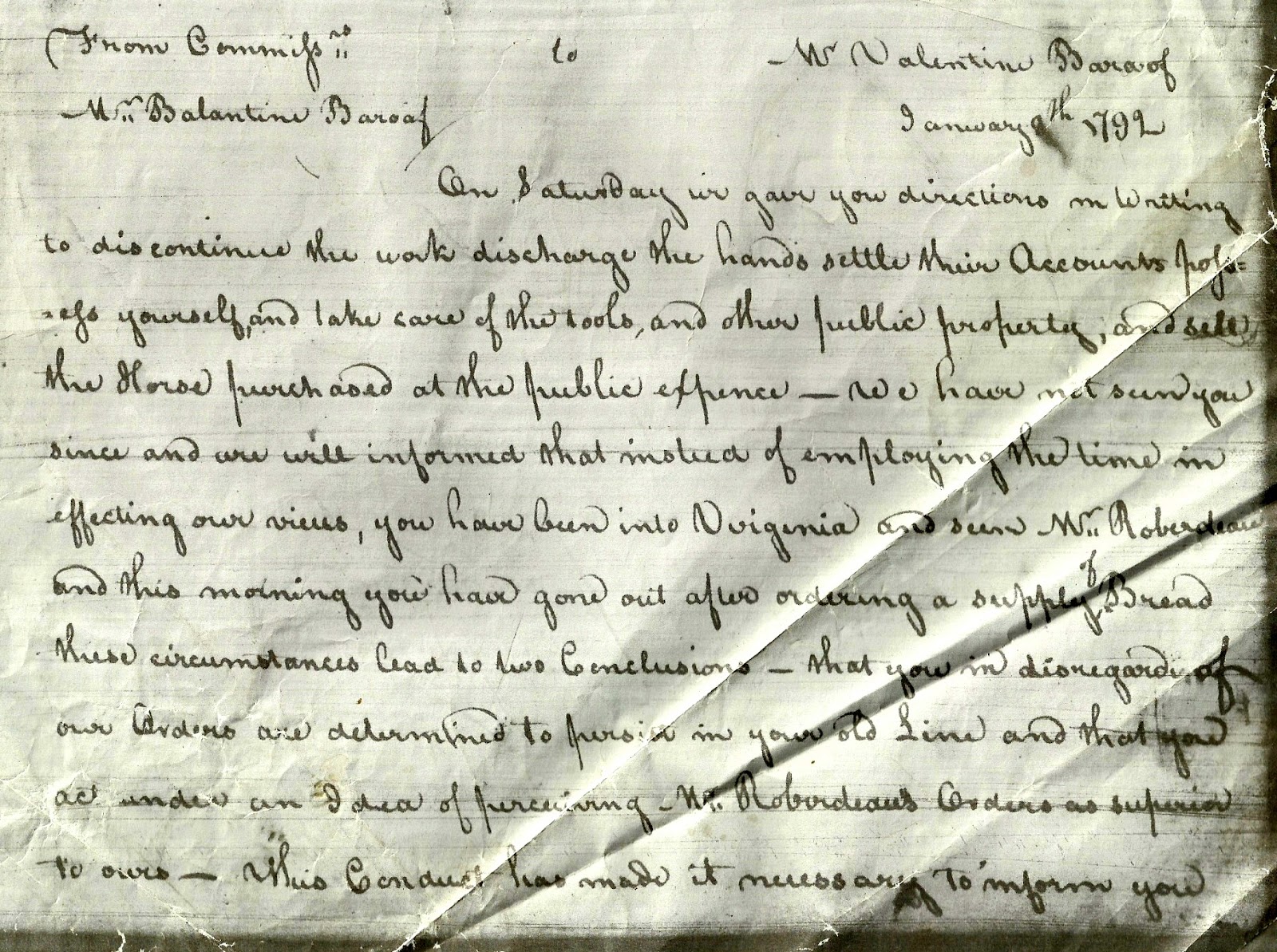
The commissioners fired all the workers hired in early January. Letters generated by that, also copied below, give more evidence that none of the hands hired were slaves,


The commissioners January 9, 1792, letter to Valentine Boraff, the commissary  hired to feed the workers, clearly shows that the workers L'Enfant hired were not slaves. In the first sentence of the letter below the commissioners note that they had ordered Boraff to "discharge the hands settle their Accounts...." The commissioners never set up an account with a slave. All the money earned by all of the slaves that they subsequently hired went to the slave's master.

Below that letter I add two letters from Boraff as he tried to adjust to his dismissal and get reimbursed for money he had advanced for the work including $30 for a horse he bought because he had to ride so often to Georgetown to get supplies. He worked for 179 days for $1 a day. He wrote the second letter to Roberdeau who after being fired conspired with several Georgetown speculators to continue to pay the fired laborers. Roberdeau left the city leaving Boraff to deal with the laborers when he could not pay them. This is another indication that none of the laborers were slaves since once dismissed their  masters would be obliged to care for them.

Finally there is a receipt reimbursing Roberdeau  for feeding the fired laborers until January 21. I think Roberdeau reimbursed Boraff back in 1792.


Thursday, November 19, 2015

1791 letter about the brick making business

Before the commissioners hired Collen Williamson or James Hoban, they tried to hire a master brick maker. In November 1791 when Francis Cabot, a Yankee merchant left Georgetown for home, the commissioners asked him when in Philadelphia “to enquire on what terms we could get some of the most experienced brick makers to come here early in the spring.” But the report Cabot sent back made brick makers seem pretty expensive.
Quote from Slave Labor in the Capital, page 115

How essential slaves were in the brick making business is a hard to estimate. Some historians think it was the worse job they were forced to do, especially since by tradition children were used. I think brick making was probably the best way for slaves to exhibit skills that could allow them to make extra wages and thus, in time, buy their own freedom. However, I can't point to any slave who made bricks for the Capitol and White House who ever got extra wages let alone buy their own freedom. 

I can't make my case because the commissioners never hired brick workers. They used contractors to make their bricks. However, I think one of the first contractors hired in 1792, William Hill, was a free black and according to Jesuit records he was a slave in the 1760's. 

Two of the commissioners, Thomas Johnson and Daniel Carroll of Rock Creek, were slave holders who likely used bricks in their personal building project. In the 1780's a traveler said members of the Carroll family built a house with bricks that were made by their own slaves.However judging from their correspondence in late 1791, the commissioners looked to Philadelphia to find someone to run their brick making operation.

One can dismiss this as  a public relations ploy to spread the word in the then capital that the new capital was on its way, but the commissioners persisted in the quest and a Philadelphia brick maker they almost hired in 1793 did come to the city though he worked, I think, as a contractor. He even supervised the brick making for the scion of the Carroll family in the city, Daniel Carroll of Duddington. 

Certainly the man the commissioners asked to find a Philadelphia brick maker took their request seriously. The letter below describes the wage rates for the overseer of the burning and molders, and notes that laborers "conduct the rest of the business." The letter does not mention the race of the brick workers in Philadelphia. But the letter, I think, suggests the mobility inherent in brick making. Both the laborers and molders got their hands dirty and with the same clay. Only the most foolish contractor would deny an African American laborer a try at becoming a molder. If he worked in a city, a slave molder would understand the value of his labor, and finding himself the most essential cog in a manufacturing process might perhaps be able to leverage some advantages.

Below the letter from Cabot is the November 26, 1791, letter the commissioners wrote to Cabot in which they ask him to find several brickmakers.