How to buy the book

You can order at History Press as well as Amazon, Barnes and Noble and other on-line retailers. I will send you a signed copy for $23, a little extra to cover shipping. I will send you both Slave Labor in the Capital and Through a Fiery Trial for $40. Send a check to me at PO Box 63, Wellesley Island, NY 13640-0063.

My lectures at Sotterley Plantation in St. Mary's County, Maryland, on September 23, 2015, and the DAR Library on December 5 are now blog posts below listed under book talks. The talk I gave
at the Politics and Prose Bookstore on February 28, 2015, along with Heather Butts, author African American Medicine in Washington, was taped by the bookstore. Take a listen.
Showing posts with label masons. Show all posts

Wednesday, November 18, 2015

Stone masons quit and a lecture on employee relations

"Plus, the easier way to build the workforce was not by advertising for slaves but by using the network of friends and relations that free workers had."

Quote from Slave Labor in the Capital, page 71

"Observers were impressed by the 'spirit' with which the masons worked. Since one story of a stone building had  to sit at least a year before the second story was added, the masons expected to begin work at the Capitol. They didn't expect to be told by the commissioners that they had to work under McDermott Roe and that those whose wages were due to be renegotiated had to work by the piece."

Quote from Slave Labor in the Capital, page 89-90

Letters written by the commissioners, President Washington, and Secretary of State Jefferson can give the impression that there was a shortage of workers in Washington and that workers from Europe had to be recruited. In reality there was no shortage of workers. The press to recruit emigrants arose because since they could be legally bound to pay off their passage money, they would be cheaper than free workers already in the country or emigrants who paid their own passage.

When the commissioners changed the way of paying mason, many of them quit and left the city. Benjamin Stoddert, the Georgetown merchant and speculator, wrote to the commissioners chiding them for spreading disaffection that would stop the flow of workers to the city: "The report of such men will have more affect upon the minds of mechanics than everything that can be said in contradiction from authority the most respectable."


Tuesday, November 17, 2015

How much was the work the hired slaves did worth?

"The laborers’ job then was to get it from the stone yard or stone workers’ sheds using the stonecutters carts. As the masons built up the foundation walls, the laborers used pulleys to get stone down to carts next to the wall and then pushing the carts to the masons and under their instructions lifting it so they can set it in place. Inclined planes and poles to leverage the stone probably helped. Laborers probably also brought mortar to the masons and perhaps mixed it. There was a horse driven machine to mix the lime. When a horse wasn’t available the hired slaves did all the work. That seems a plausible explanation of what the slaves did. No one described it at the time."
 Quote from Slave Labor in the Capital, page 87

Going through the documents I copied for this blog, I found a better short description of how the laborers helped the stone masons. John Dobson, an Englishman, made a piece work contract with the commissioners describing the prices for all the types of stone work necessary all on condition that the commissioners provide laborers "to hoist and haul stone onto the scaffolds." That quote is at the bottom of Dobson's letter. I copy that letter at the end of this post. Unfortunately for all the figures in it, Dobson's letter doesn't help us estimate how much the work of the laborers tending masons was worth.


While there was little written about what the hired slaves actually did, and no estimate of how valuable they were to the project even though they were hired as a cost saving measure, we can get answers to those questions by looking closely at what was written about skilled workers. Thanks to the commissioners forcing their masons to get paid on a piece-work basis, a group of masons estimated the value of "sufficient attendance" that is to say, having laborers tend masons. They offered to work for 4/6 per perch of stone laid without "having all the materials laid down convenient to the building" or for 3/6 per perch with that help. So they valued the work of the laborers who tended the masons at one shilling, roughly 13 cents, for each perch laid.

Since the masons also offered to work for 11/3 per day, we can estimate that a mason generally laid 3 to 4 perches of stone a day. One perch of stone wall is 16 ½ feet long, 18 inches high and 12 inches thick. So a day's work for a mason and the laborers attending him entailed moving and setting 10 to 12 slabs of freestone. The North Wing of the Capitol was 120 x 126 feet and 70 feet high.

We the under named Masons, who were induced to come from different parts of the continent to the Federal City, under expectations of meeting with good wages, but who now find ourselves out of employ, certainly from no fault of our own, after having been a considerable time engaged in the Public service, performing our work faithfully and to the full satisfaction of our employer, beg leave to offer our services to the Publick on either of the following conditions.
We will build the foundation of the Capitol to the height required with rough stone, in a workman like manner which we are qualified to do, at 4/6 per perch - having all materials laid down convenient to the Building - And if found with sufficient attendance we will do the same for 3/6 per perch - Or we will work at 11/3 per day. But no man who is a Tradesman will submit to work under those who are not. We therefore cannot work under McDermott Roe & cannot help thinking it very hard that we should be told we must work under him, or be discharged, after having worked so long for the publick without complaint against us.
We have heard assigned as a reason for the change which has taken place in the manner of conducting the Public work - that the Masons who were at work at the Capitol - idled their time and did not do their duty. This is not true, whoever may have made such representations to the commissioners - Let the work done this Spring be fairly estimated and it will be found that each Mason employed fully earned his wages, allowing the rate per perch at which McDermott Roe has contracts - with this wide difference in favor of the masons - that their work will stand the test of the severest examination, and McDermott Roe's is totally unfit for such a building, and must be undone or the House will be ruined, which we are willing to prove. It is also said as a reason for the change, that the masons refused to work without their wages were raised from 10/ to 11/3. This is not true, the Masons said not a word about their wages until after they were told by Mr. Hoban that those who did not choose to work under McDermott Roe might go about their business - They were well satisfied to continue as they had done for twelve months before at 10/ a day. - But after being discharged they had a right without any imputation upon them to hold their future services at what they thought proper
Robt Brown, James Maitland, John Delahunty, Thom? Maitland ( ?, 1794)


Sunday, November 15, 2015

Incipient racism: Williamson's letters to Presidents Washington and Adams

 In 1794 after the commissioners fired Collen Williamson who they had hired to superintend the stone work at the White House, he tried to get his job back, even suing the commissioners for what we would call today "age discrimination." He was 65 when he was fired. In the two letters below written in 1797 he wrote to Presidents Washington, who left office in March, and Adams, arguing that he could have saved thousands of dollars for the government if he had not been fired.

I copied his letters because he often boasted of his accomplishments and denigrated James Hoban who he blamed for his dismissal. Hoban hired the man, McDermott Roe, who hired the Irish stone masons who replaced the men, mostly Scots, that Williamson had hired. Those Irish masons did the poor work which led to walls collapsing at the Capitol.

In the letter to Washington he mentions the "negro's" who attended the 30 Irish masons.


In his  November 1797letter Williamson rather expanded his attack on Hoban and this time rather than just mentioning the slaves, he denigrates them as not equal to white workers. " They likewise have among them ten or twelve negro apprentices and drawing wages for them six of them is not equale to one good hand."

Here is my transcription of  first part of the letter.
City of Washington, November 27, 1797 Honorable Sir, I should not have troubled you in writing but considering myself still in the public employ, I think it my duty to give information of what has been going on here for too long a time. There is a James Hoban, an Irish carpenter engaged as arcteck for the President's house from Charleston and soon after came acompany of thives his former associats being three in number. those men most all of them he putt in places of trust, one is made overseer of the carpenters and charge of all the lumber at the presidents house, the second foreman of the carpenters at the capitole, the third store keeper of the repository where all the white lead and oil paints nails spads and c are stored for the use of the work, the above trusties have built for themselves five or six houses mostly out of public materials which proof is as follows, and has been proven the painter stored ninety four gallons of oile, at ten shillings per gallon, out of which they stole seventy nine, the public got onlt fifteen gallons of their own oile, the painter reported to your nominal commissioners and then an investigation was mead, the oile and lumber proven I have it to the judgment of others how much the other materials has disappered, by being under such hands, they likewise have among them ten or twelve negro apprentices and drawing wages for them six of them is not equale to one good hand, the gentlemen here says it was good policy in Hoban to get me putt out of place fore then there was non to restrain them, they did as they pleasd, this man have been a recepticle for all the Irish vagbons that came in his way, there is noting here but fighting lying and stealing and will be as long as this man is in power...
Other than Williamson age and frustration, a change in the commissioners' attitude toward Hoban might account for the petty viciousness and racism of Williamson's attack. As they ran out of money the commissioners paid more credence to complaints about Hoban's management style as he superintended the construction at White House. He had full command of the facts and was the only man who give the commissioners the information they needed to persuade congress to rescue the project. But Hoban also rewarded cronies and by hiring his own slaves as carpenters or apprentice carpenters managed to make more money than a commissioner.

In an effort to clip Hoban's wings, the commissioners required better supervision of building materials and banned the hire of slave carpenters. Did the commissioners' disciplining Hoban embolden Williamson to impugn the slaves which he had refrained from doing in his earlier letters? Perhaps that, and an expectation that John Adams, a northerner, would respond to his impugning slaves.

Neither president answered Williamson letters. They were forwarded to the commissioners who ignored his letters.


Tuesday, March 17, 2015

HIred slaves "were a check on the white laborers."

"There were 'none so good for cutting before the Surveyors.'....there were 'none better for tending Masons.'"

Quotes from Slave Labor in the Capital, pages 53 and 86

In their January 5, 1793, letter to Samuel Blodget, the commissioners highlighted the success of their slave hire policy to the man they just hired to take over the day to day handling of their affairs. The commissioners met only once a month. I cut the photocopy I made of the commissioners' letterbook copy of the letter into three parts so that I could scan it. In the first scan they discuss the arrangement with Blodget. In the second, they joke about their trying to get more "foreign mechanicks" than they need and their need for stone cutters. In the third they report that they have enough carpenters, are trying to get a Philadelphia brickmaker and "may have a good many Negro Laborers."

Unfortunately they don't say how many they had in 1792 or had hired for 1793. They do laud those they hired in 1792 for their work with the surveyors and masons. "Cutting before the Surveyors" were hired slave axe men. In saying "none better for tending Masons" the commissioners were quoting Captain Williamson, who I am pretty sure was Lewis Williamson, the son of Collen Williamson the old Scottish mason hired to supervise the stone work at the White House. The hired slaves probably formed part of the crew that moved stone to the stone cutters sheds at the White House. Pity that there is not a fuller description of their work. Of course, the point the commissioners were trying to make is that their slave hire policy was good because the slaves were good workers and put free workers in their place. The commissioners echoed what they had just written to Secretary of State Jefferson, that memorable phrase that the slaves "kept our affairs cool," by telling Blodget that the hired slaves "were a check on the white laborers...."

Blodget was a Massachusetts spectacular who boasted of many talents. Supervising a major building project proved not to be one. He was seldom in the city and soon fired. That's another story well covered in my book Through a Fiery Trial.


Thursday, March 5, 2015

Want ads can reflect how blacks were used

"It is tempting to suggest that as more white workers came to the city slaves were crowded out, but as those white workers earned money some bought slaves. Recall all the inconveniences of the city, including distances from shops to work sites where the workers lived. Slave servants walked the extra miles for their master, as well as kept house."

Quote from page 136, Slave Labor in the Capital, page 136

The want ads in the local newspapers can show us how whites regarded and used slaves and free blacks. In the first ad below, Massachusetts born William Cranch, the nephew of Abigail Adams, wanted a maid for his growing family. He offered wages and made "no objections... as to colour." Since he offered "good wages" he likely knew of free black women in the community who were house maids.

The second advertises an auction of the estate of a deceased mason named James Harrigan. I have not found him on a payroll yet so he may not have worked on the public buildings. However, I think his  estate mirrors that of many other masons who were immigrants. His estate consisted of mason's tools, clothing and two slaves "accustomed to housework," a 16 year old girl and a 9 year old boy. Immigrants rarely had family to help with chores. They could easily buy slaves.

The third ad solicits quarriers for the Seneca Creek quarry. Unlike Robert Brent's ads for the Aquia Creek there is no mention of 25 or 60 slaves. Paxton and Delahunty wanted a few good men who wanted liberal wages.


Saturday, January 10, 2015

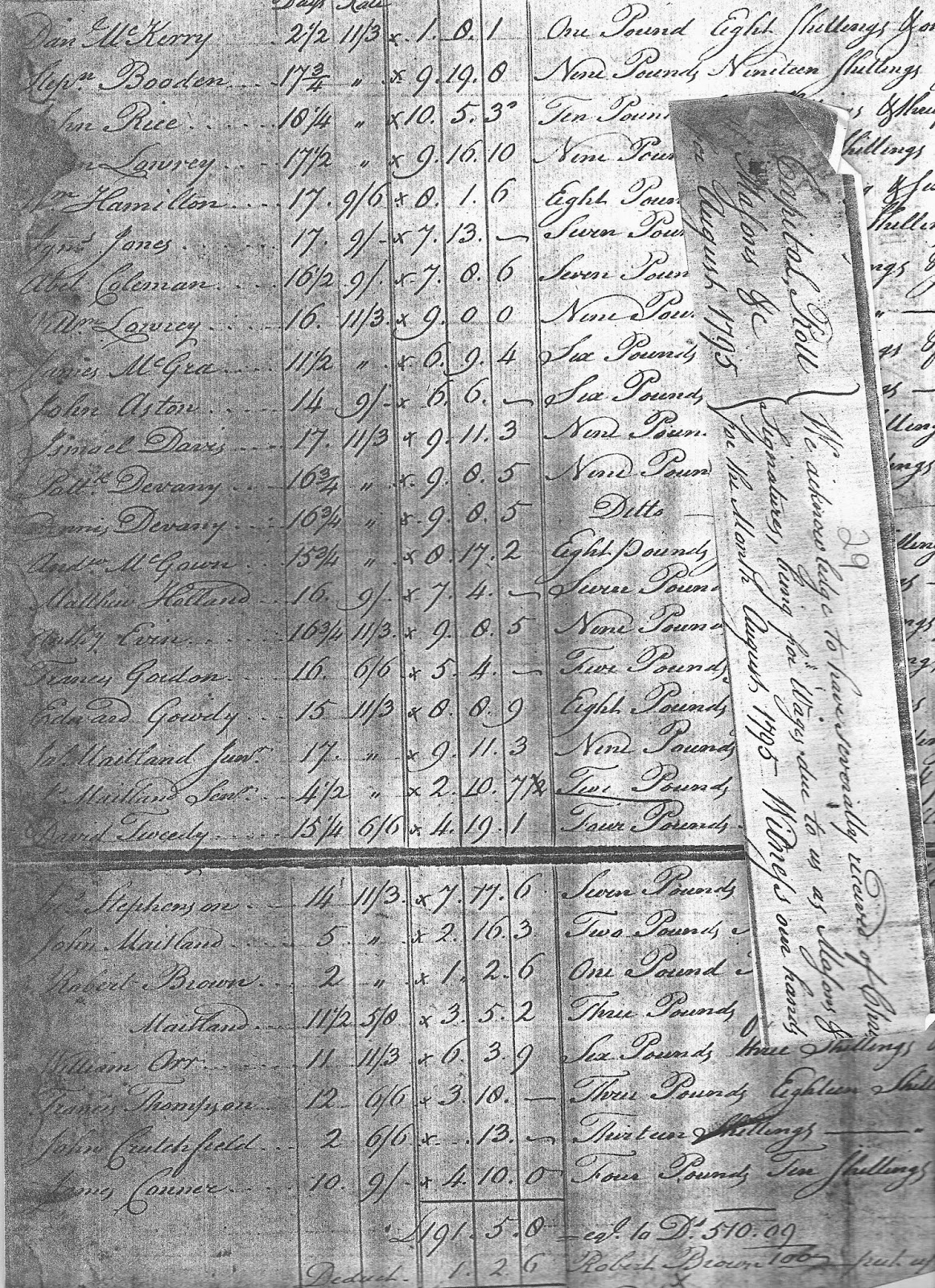
1795 September & August payrolls for stone masons at Capitol

"Criticism from the president and secretary of state prompted the commissioners to question McDermott Roe's masons. As they built their case against him, they also cleared masons who didn't seem involved in the shoddy work. They rehired them to work for wages, not by the piece."

Quote from Slave Labor in the Capital, page 92-3

These payrolls for masons at the Capitol for August & September 1795. They were all white workers, many of them emigrants. The payrolls show men with Irish names who had likely been recruited by McDermott Roe working with men with Scottish names likely recruited by Collen Williamson and his son. The laborers hired by the commissioners, most of them hired slaves, "tended" the masons. That is, they moved the stones from the stone yards after the stone cutters had finished with them to the walls of the buildings and then raised them using cranes, blocks and tackles up the scaffolding, if needs be, so the skilled masons could set the stone. Laborers or in the case of slaves were paid by the month or year. These payrolls for masons show that every man worked for days wages, but the rate, in Maryland shillings, varied from 7/6 to 11/3. I found no explanation for that in the commissioners' records (which doesn't mean none is there.) There are other things in the payroll I can't explain. In September no one worked more than 17 days and in August 18 1/4 days, and several men worked far fewer days. There were some heavy rains in August which may prevented work on the walls.  When compiling my list of men who worked on the public buildings I neglected to include men on this payroll. Only two of the men on this payroll, James Stephenson and James Maitland, were included in the lists in Slave Labor in the Capital's appendix and they were listed not as stone workers but bricklayers. So add to that list of workers a man named Aston whose first name is illegible, William Bishop, Sr and Jr, Patrick Bryan, Abel Colman, James Connor, Israel? Davis, Dennis and Patrick Deveany, Anthony Even or Iven, James Gordon, ? Gowdy, William Hamilton, Matthew Holland, ? and William Lowry, Andrew McGown, James McGrath, and David Tweedy. I print out their names to make searching easier for genealogists. Also interesting is that 6 of the 21 men on the September payroll were evidently related. Bishop Sr. and Jr. earned the same top wage.