How to buy the book

You can order at History Press as well as Amazon, Barnes and Noble and other on-line retailers. I will send you a signed copy for $23, a little extra to cover shipping. I will send you both Slave Labor in the Capital and Through a Fiery Trial for $40. Send a check to me at PO Box 63, Wellesley Island, NY 13640-0063.

My lectures at Sotterley Plantation in St. Mary's County, Maryland, on September 23, 2015, and the DAR Library on December 5 are now blog posts below listed under book talks. The talk I gave
at the Politics and Prose Bookstore on February 28, 2015, along with Heather Butts, author African American Medicine in Washington, was taped by the bookstore. Take a listen.
Showing posts with label labor strife. Show all posts

Thursday, December 3, 2015

Proof that L'Enfant did not hire slaves

"He didn't hire any slaves."
Quote from Slave Labor in the Capital, page 38

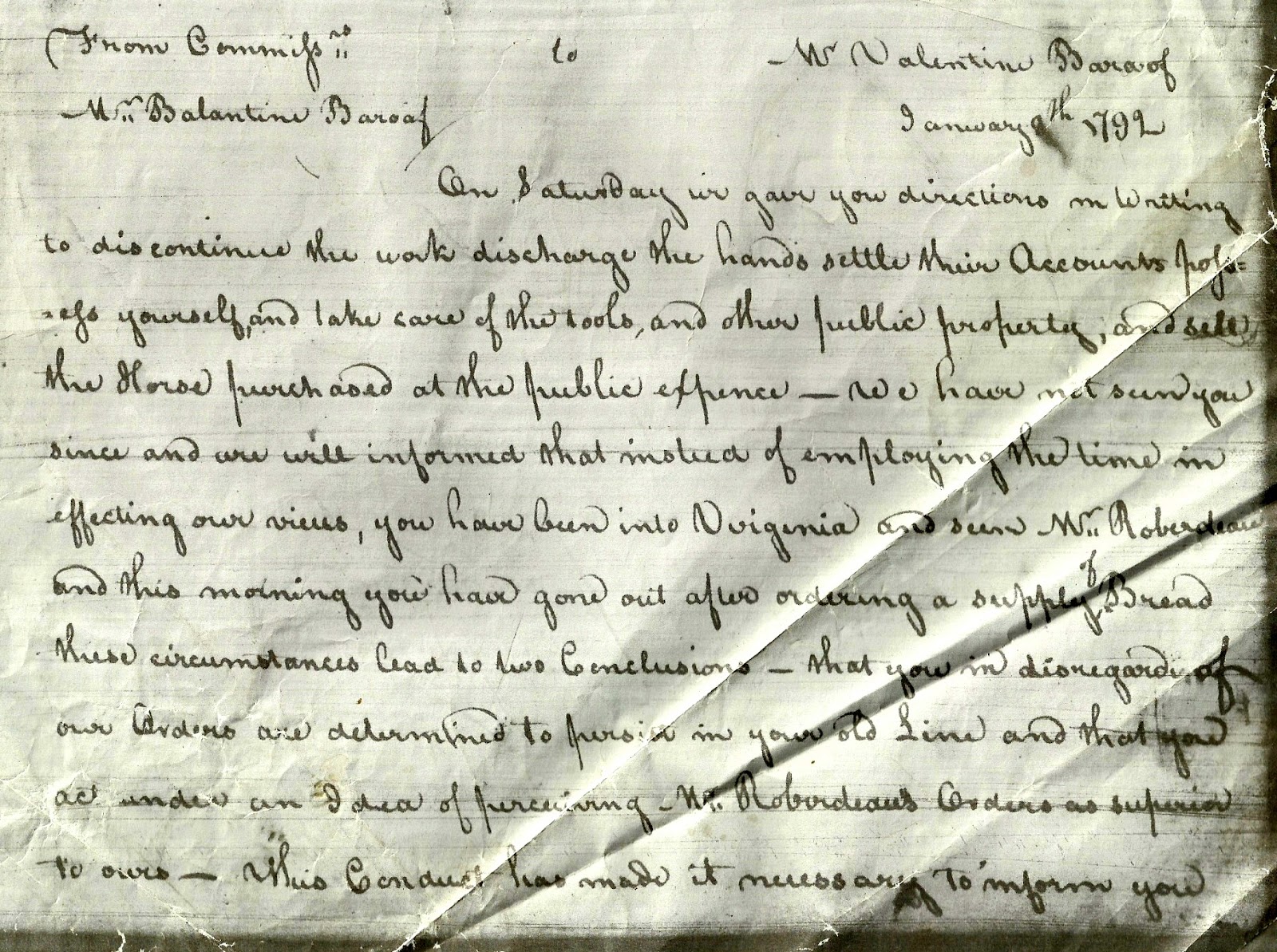
In September 1791 the commissioners authorize L'Enfant and Ellicott to hire 150 laborers. They managed to hired 75. There is no evidence that any of them were hired slaves. After those laborers were fired, the commissioners resolved to hire slave laborers. They would not make such a pointed resolution if they had already hired slaves. In the first document below, a letter to L'Enfant and Ellicott, the commissioners express their disappointment that 150 laborers were not hired. They worried that more "hands" were needed to get the city ready for an auction of lots in a few weeks. All three commissioners were slave owners, but they don't suggest the hiring of slaves. They suggest offering higher wages, "an advance price for a fortnight or a month."

The commissioners fired all the workers hired in early January. Letters generated by that, also copied below, give more evidence that none of the hands hired were slaves,


The commissioners January 9, 1792, letter to Valentine Boraff, the commissary  hired to feed the workers, clearly shows that the workers L'Enfant hired were not slaves. In the first sentence of the letter below the commissioners note that they had ordered Boraff to "discharge the hands settle their Accounts...." The commissioners never set up an account with a slave. All the money earned by all of the slaves that they subsequently hired went to the slave's master.

Below that letter I add two letters from Boraff as he tried to adjust to his dismissal and get reimbursed for money he had advanced for the work including $30 for a horse he bought because he had to ride so often to Georgetown to get supplies. He worked for 179 days for $1 a day. He wrote the second letter to Roberdeau who after being fired conspired with several Georgetown speculators to continue to pay the fired laborers. Roberdeau left the city leaving Boraff to deal with the laborers when he could not pay them. This is another indication that none of the laborers were slaves since once dismissed their  masters would be obliged to care for them.

Finally there is a receipt reimbursing Roberdeau  for feeding the fired laborers until January 21. I think Roberdeau reimbursed Boraff back in 1792.


Monday, March 9, 2015

Labor strife with stone cutters May 1, 1798

"The Negroes Alone Work."

Quote from Slave Labor in the Capitol, page 11

John Miller was drawn into the affairs of the city by the bankruptcy of James Greenleaf. With other Philadelphia merchants and speculators he was one of the trustees trying to manage the Washington property of Greenleaf so that his creditors could be paid. It was a rather large problem. Greenleaf had just over $2 million in debts and few wanted to buy Washington real estate. In this letter, Miller was commiserating and trying to bolster the courage of one of the commissioners who faced the same problem. The sale of building lots in the city was supposed to finance the construction of the Capitol and White House.

Alexander White was a former Virginia congressmen and spent most of his time as a commissioner lobbying for appropriations and loan guarantees from congress then meeting in Philadelphia where he likely became acquainted with Miller.

Then as now when things were not going well, the ruling class was prone to blame the working class, in this case the stone cutters. The number "68" on the scan of the photocopy is mine and refers to chapter 68 of my book on the founding of Washington, Through a Fiery Trial. As it turned out, I wrote about this dispute with the stonecutters in Chapter 67. In a nutshell, the commissioners fired their stonecutters on expectation of getting replacements from Philadelphia, as per Miller's letter. But then they were persuaded that no one would come down from Philadelphia to get the same wage. An agreement was reached but the whole month of May 1798 was a difficult one for labor relations. Carpenter were also disputing their wages.

However, there was no problem with the yearly hires, the vast majority of them slaves. This was when the Polish tourist Niemcewicz visited and noted that "The Negroes Alone Work." I think he got that impression because of the surly disposition of the free workers until wages and working rules were settled. In addition, the task at hand was getting the heavy timbers of the roof in line and I think skilled workers were loath to stoop to such labor. Surely, if ever the whip was used on the slaves as they worked on the Capitol this was the time, but Niemcewicz was there and didn't see it or hear about for surely he would have reported it. I don't think he would have reported on the labor dispute. At least, his diary showed no interest in that, while he did comment on the treatment of slaves.