How to buy the book

You can order at History Press as well as Amazon, Barnes and Noble and other on-line retailers. I will send you a signed copy for $23, a little extra to cover shipping. I will send you both Slave Labor in the Capital and Through a Fiery Trial for $40. Send a check to me at PO Box 63, Wellesley Island, NY 13640-0063.

My lectures at Sotterley Plantation in St. Mary's County, Maryland, on September 23, 2015, and the DAR Library on December 5 are now blog posts below listed under book talks. The talk I gave
at the Politics and Prose Bookstore on February 28, 2015, along with Heather Butts, author African American Medicine in Washington, was taped by the bookstore. Take a listen.
Showing posts with label slave quarry workers. Show all posts

Friday, November 6, 2015

Commissioner Johnson solved problems with slaves

"The commissioners blamed Cooke and Brent for making deliveries after the hired slaves were sent home for the year."

quote from Slave Labor in the Capital, page 83

"The commissioners placed their next ad in the fall of 1794, angling for sawyers to work through the winter just as Hoban wanted."
quote from Slave Labor in the Capital, page 102

I should have written Commissioner Thomas Johnson because in the record, it appears that Johnson was alone when those decisions were made. Indeed the hand writing in the official record is Johnson's not the usual clerk's. Usually at least two of the three commissioners signed such orders.

I think this one page in the record, written by Johnson, bares his approach to work in the city. The nagging problem of amassing building materials to put in the hands of skilled workers was best solved by the use of slaves. True, the first order objects to stone deliveries after the "discharge of laborers hired by the year," but that reflects the reality. All the laborers were not slaves.

The last item on the page is a draft for a help wanted ad. It makes no mistake about the nature of the help wanted: "a number of slaves to labor in the brick yards and stone quarries for whom generous wages will be given." Not "to whom" but "for whom." Masters stood to profit not the slaves doing the work.

In the fall of 1794, getting tree trunks sawed into lumber had been a problem for almost two years. Judging from this ad, the commissioners realized that in Maryland slaves did most of the sawing. The commissioners did not like to recognize that slaves had skills. They hired them to keep down the price of labor and didn't want slave masters to think they could get more money out of them. This ad does not explicitly say "slave sawyers," but coupling sawyers with laboring slaves makes pretty clear that the audience for the ad was masters, not free workers. It also showed that grudgingly the commissioners realized that slaves had at least one skill warranting a higher wage.


Thursday, November 5, 2015

Quarry letters II

"To meet the demand for more stone, the sons of Virginia plantation owners gave way to stonecutters who actually knew the business."

Quote from Slave Labor in the Capital, page 73

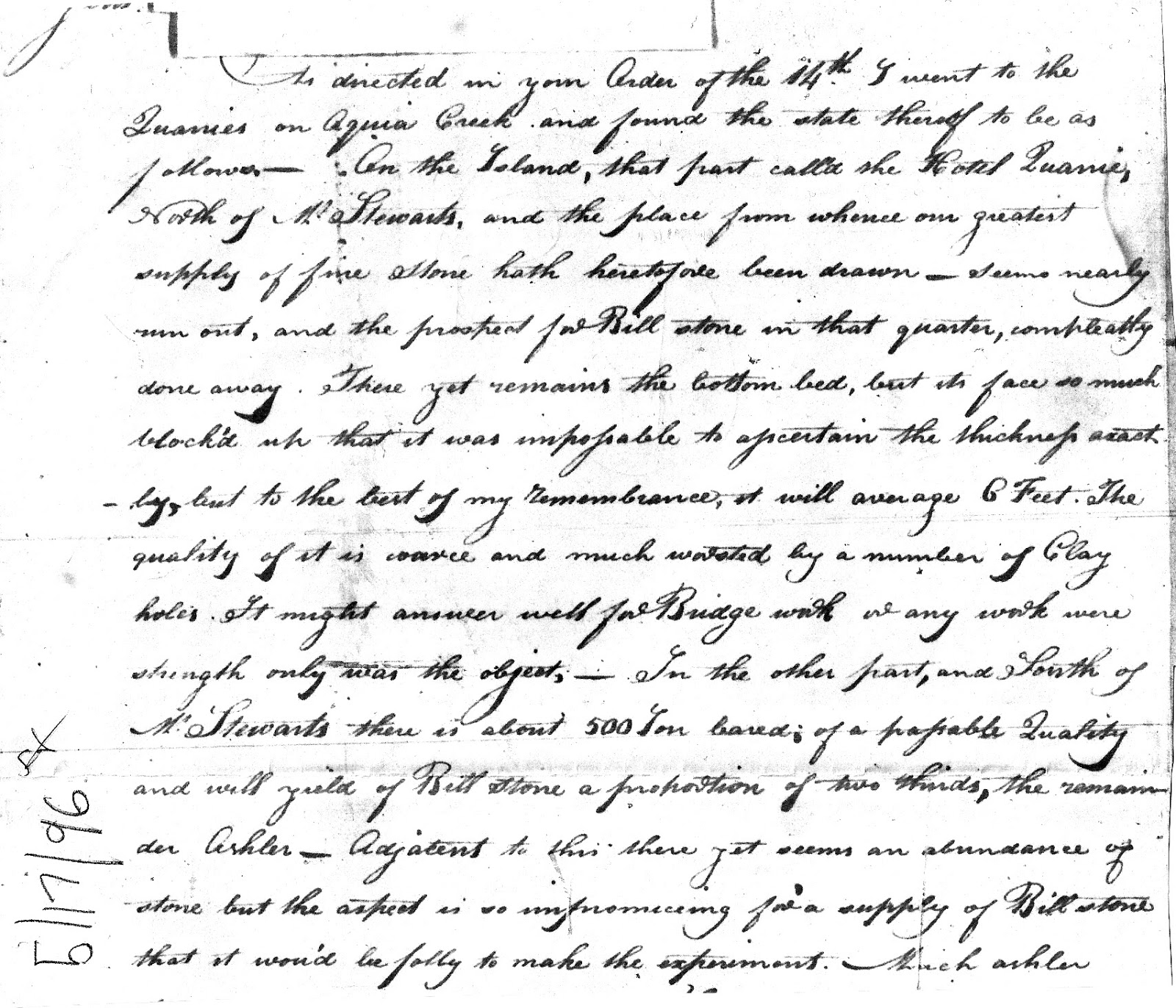
By 1798 the quarrying operations at Aquia had grown and the two letters below show how the stone cutters involved responded to the crisis when a ship with 40 tons of stone sank in Aquia creek. There is no mention of hired slaves in either letter. But the letters describe the crisis at the Brent quarry.  The stone in the sunken ship had to off loaded and the ship raised. To get more stone from the quarry a layer of soil had to be removed. It is hard not to picture slaves doing such hard menial work. This was a quarry operated by the Brent family that had long owned slaves in Virginia.

However, the letters also reveal a network of British stone cutters who seemed to have effectively taken charge of stone operations. From payrolls we know the David Ogilvy and George Blagdin (usually spelled "Blagden") were doing stone work at the White House in December 1794. I think Richardson was one of the White House stone cutters lured to Aquia in 1793. Richardson seemed eager to save the day promising to get out the stone needed in Washington from his neighboring quarry. This possibly is when Richardson's quarry became the primary source of sandstone for the Capitol. In my book I quote Benjamin Latrobe's 1806 description of how sandstone was quarried. He was at the Richardson quarry checking on the stone deliveries he needed to continue work on the south wing of the Capitol.

Of course, neither of my books goes into great depth about the quarry operations. I share these letters to show that there is much information in the records, though little explicit about race and the work force at the quarries.


Wednesday, November 4, 2015

Quarry letters I

In May 1795 they explained their late deliveries by telling the commissioners that "new hands are hard to get" and "wages and provisions higher than in the Fall."

Quote from Slave Labor in the Capital, page 73

"The lives of the hands endangered by lifting heavy bill stone."

Quote from Slave Labor in the Capital, page 83

The commissioners returned the Aquia quarry to the Brents in late 1794 so the government records do not included payrolls beyond that date. We know from advertisements that they put in newspapers that the Brents wanted to hire slaves to work in the quarry. I have never found documents even suggesting how many they hired, but since the government continued to rely on the Brents for stone, there are letters in the records discussing the problems they faced.

In the letter below the Brents promise more stone but warn that "at this time of the year [May] new hands are hard to get. Wages and provisions higher than in the fall." This suggests that they were looking to hire free laborers since, as far as I am able to tell, the terms for hiring slaves did not vary. Plus, slaves were generally hired out at the first of year.


The second letter in this post describes the dangers of unloading the stone at the commissioners' wharves. In general, there was more regard for slave laborers than for Irish laborers. The former were worth something to the slaves owners. There is no evidence that laborers were segregated by race, but I think the concern expressed in this letter suggests that slaves mostly did the off loading at the wharves.


Thursday, March 19, 2015

William O'Neale letter on unloading stone

"O'Neale thought much of the shifting around was pointless. He told the commissioners that the wharves should be modified so that the wagons carrying the stone away could be placed so that the crane at the wharf could load the stone directly onto them."

Quote from Slave Labor in the Capital, page 81

The letter William O'Neale wrote to the commissioners in September 1794 is interesting on several levels.  Primarily it's interesting because it is our best description of how the stone was unloaded and hauled away. The letter also gives the impression that working arrangements had not been well thought out. Plus, perhaps there was some confusion about who was in charge. O'Neale wrote to the commissioners who had no experience in such matters, not to James Hoban or Collen Williamson who did. 

Finally, O'Neale came to the city as a young Irish emigrant who knew about quarrying building stone. He wound up many years later as the proprietor of the Franklin House, a favorite inn and boarding house for politicians. He would eventually own 17 slaves. The laborers he bossed as they unloaded stone in 1794 may have been the first time he worked with slaves. The letter gives the impression that he was not impressed with the laborers and how they were employed. He doesn't mention the race of the laborers. They were either slaves or Irish. That O'Neale described them as skulking suggests to me that he was showing his disdain for slaves. He probably would have used a more forgiving word if Irishmen were involved.

As far as I know, the commissioners didn't respond to O'Neale. At the end of the year they insisted that the contractors they bought stone from bear the responsibility of getting the stone to the building sites.


Friday, March 6, 2015

Work arrangements before slave hire

"The commissioners encouraged Williams to hire men who work by the job, not on time wages and expecting chocolate butter for breakfast...."

Quote from Slave Labor in the Capital page 42

One result of the commissioners firing L'Enfant's workers in January 1792 was that they had to find somebody to organize the work that had to be done and this time they would not give nebulous orders to proceed, as they did with L'Enfant. They tried to give explicit orders. That was difficult because they really didn't know how to go about such a huge and unprecedented project, unprecedented in this country at least.

I share the scans of two documents I photocopied from the microfilm reels of the commissioners' proceedings made by the National Archives. The first is the commissioners' contract with Elisha Williams who they put in charge of the work. The second is their instructions to Williams outlining what they wanted him to do after the commissioners' adjourned and left Georgetown.

I didn't crop the first scan to exclude other matters the commissioners dealt with. I am always accused of sharing too much detail in my books. Here's a chance to show the many details I didn't share.

Four months after hiring Williams, the commissioners instructed him to hire slaves. That raises the question: when they hired Williams did they already expect to hire slaves? Williams was to be the "overseer," be in charge of "provisions" for workers, prepare for brick making and get timber to build huts to get ready for work in the Spring. Another order asked him to get the huts built by Spring.

But he was to overseer of those laborers those "who do work on priced time." When the commissioners hired slaves, they hired them for a year. If they expected Williams to exclusively handle slaves, they might of simply said he would oversee yearly hires.

These documents show that the commissioners were not thinking of hiring slaves but trying to arrange that all the work be done on a piece-work basis. That is, they wanted him to contract with men who would dig clay for bricks or cut timber for huts for a certain price. (They soon instructed Williams to hire men on a piece work basis to build the huts.) The amount of time it took them to do it would have no bearing on what they were paid. Of course, this may have invited slave owners to bid for the job and use their slaves to do it but it would free the commissioners from having to hire workers paid by the days, month or year, free or slave.


Tuesday, February 3, 2015

Receipt for quarry slaves

"Not many of the workers listed were hired slaves"

Quote from Slave Labor in the Capital, page 72

I am not comfortable with the general assumption that slaves quarried most of the stone for the Capitol. While there were periodic advertisements offering to hire from 25 to 60 slaves for quarry work, I simply can't find any evidence that that many slaves were ever hired. The scan of the photocopy from a document in the National Archives lists four slaves who did work at the commissioners' quarry. Robert Brent who served as the commissioners paymaster at the quarry also handled the shipping of  bell, likely the work bell used at the Capitol. Here is a link to payroll listing free quarry workers: quarry workers


Sunday, December 21, 2014

Ignoring a slave's last name

"Likely many of the slaves had both a first and last name, but only one hired slave was ever listed with both names in the commissioners' records."

Quote from Slave Labor in the Capital, page 26.

On page 72 of my book I briefly tell how the master of a slave named Jack Fuller was desperate to get the money due to him for hiring out his slave. Save for the only woman slave hired, Catherine Green, none of the slaves listed in the commissioners' record was given a last name. Even when slaves were on payrolls for extra wages that they kept themselves, they were listed with one name and usually without their master's last name also noted.


Other slaves were named Harry, Dick, Moses and Charles so last names might have been helpful. Maybe none of the slaves had a last name, but in the one letter I found written to the commissioners or their employees about a hired slave, the slave's master used the slave's last name. As you see below, the master John Linton made a point to refer to his slave by his full name, Jack Fuller.
 

In a receipt in which the commissioners reimbursed Robert Brent, a manager at the quarry, for paying John Linton, Jack Fuller is listed as "Negro Jack."