I
became interested in the founding and building of Washington about 30
years ago. I had grown up in Silver Spring, Maryland, so knew the
basics. I had visited the Capitol and White House. In 1969 I had
argued with a racist uncle when I was home from college reminding him
that “slaves built the Capitol.” But I became serious 15 years
after that when I set out to find out exactly how the slaves drained
the swamp Washington was built on. I found that the swamp was more a
metaphor than a physical hindrance. I also
found out that the men who built the canals in the city, which had
the added virtue of keeping the low grounds dry, were Irish
emigrants.
I
wrote a story for the Washington Post Magazine, to which I was then a
regular contributor, about there not being a swamp which sparked some
controversy. I found that not a few local historians had much
invested in there being a swamp, and voila, to defend myself I had to
become a historian. Journalism is not bad training for a historian.
You depend on sources, which for a historical topic means documents,
and you look for a story, which saves you from becoming a sociologist
or economist or worse, a know it all. Five years after becoming
serious about it, my book, Through a
Fiery Trial: Building Washington 1790 to 1800 was published in 1991.
In
the book I tried to document the contributions of slave labor but in
the 700 page book, their stories took up no more than a dozen or so
pages. In a nutshell the founding of Washington was about a handful
of white men obsessed with money, fame and power (roughly in that
order) who, though never physically or morally far from slave
servants and workers, never noticed them to the extent of describing
them or what they did.
After
finishing my book, I decided not to continue the story of Washington.
I had fallen in love with the decade, the 1790s, and I moved on to do
research on the yellow fever epidemics of Philadelphia and New York.
By the way, free African Americans played important roles in caring
for victims in those epidemics. Falling in love with the 1790s also
seduced me to embrace a simpler life. I lived in Adams Morgan and on
most nice days would walk from their to the Library of Congress or
National Archives and then walk home after a day's research. Nice
busy streets, you say, but I kept seeing what wasn't there, what had
been there. How did the water from that spring run from Franklin
square? And why did those ducks migrating north fly east across
Pennsylvania Avenue make a sharp left and fly up 7th
Street?
So,
with wife and child, I moved to a large summer home that I inherited
on an island in the St. Lawrence River, winterized it, became a
naturalist, an expert on beavers and otters, but I had brought
photocopies of all the documents I used in my research. City folk
tend potted plants, this country guy reread documents about the
founding of Washington. I especially got into deciphering the
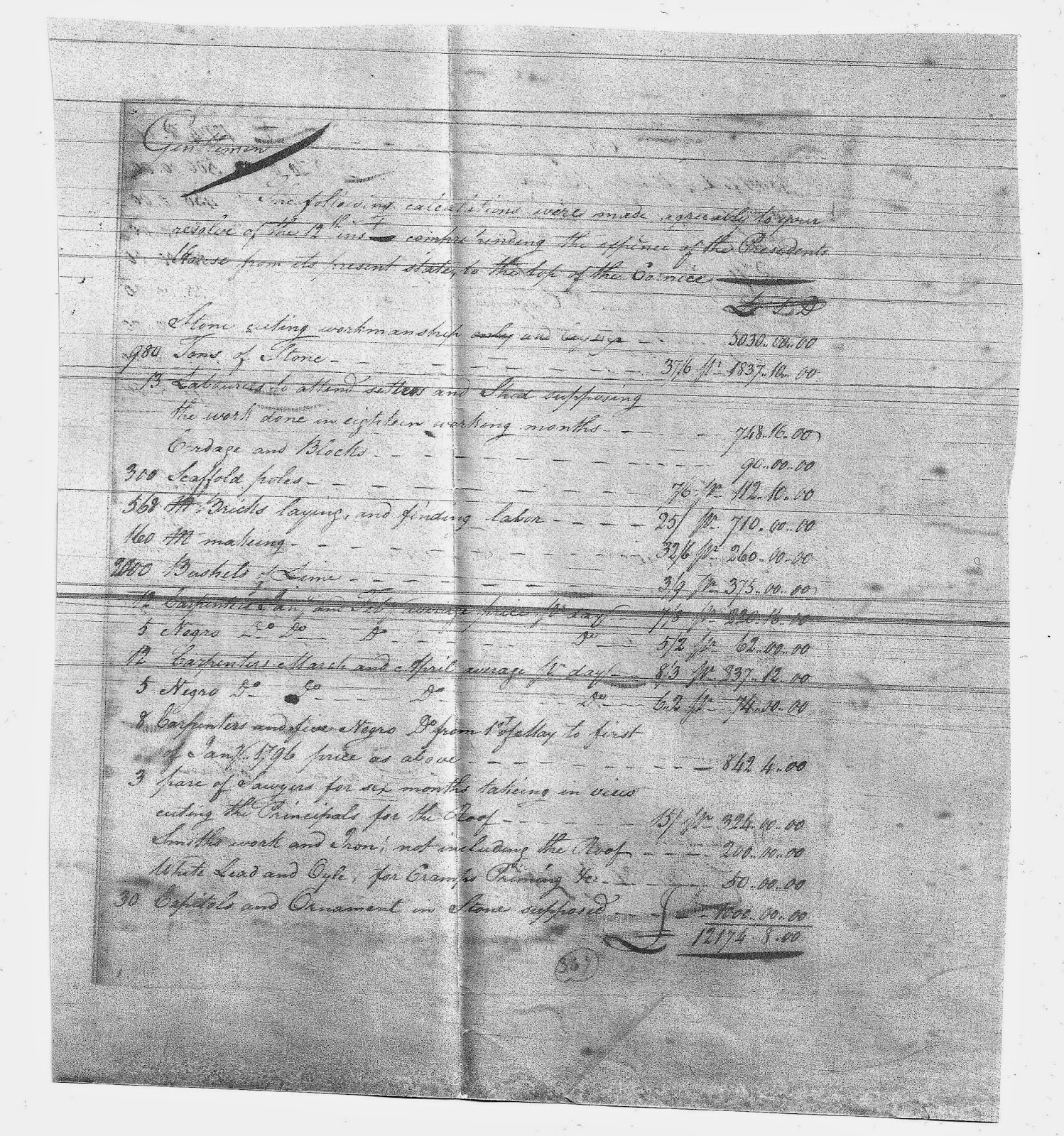
hieroglyphics, you can almost call them, of payrolls. Here were the
names of almost all the workers who built the Capitol and White
House. The slaves named lacked a last name which would have made it
easier to know what became of them but did have the name of their
master next to their first name which made it easier to know where
they came from. I periodically shared my research on the web and then
last year an editor at History Press asked me to do a book. By the
way, I still have a blog sharing documents about slave and other
workers, the sources for this book, plus updates and corrections.
Dealing with the details of history you are bound to make mistakes.
Now,
that I have a passion for documents and try to base stories on them
may raise two red flags for you. Yes, the book is built on details,
no avoiding that in this book, and I wish I had more. The text
interspersed with over 60 illustrations is only 158 pages long. As
for the stories: I find that I often didn't have much to go on. A
journalist gets used to interviewing people for an hour and then
using a one sentence quote in the resulting story. I couldn't pick
and choose like that as I wrote this book. I was sifting clues. I was
writing a book that is as much a mystery as a history.
And
what do I mean by stories? The book is not organized as a narrative
nor as a collection of small biographies. There is chapter about
where the slaves came from, a chapter about the decision to hire
them, and then chapters on their cutting trees, quarrying stone,
hauling, and lifting stone, sawing timber into lumber, and brick
making, plus I tell about the few skilled slaves used as carpenters
and one brick layer. The final two chapters discuss their living
conditions from food rations to medical care and the many jobs that had to be done in 1800, from
clearing grounds, leveling, paving, plastering, etc. to get the city ready to house the President and his family,
some 138 members of congress and about 100 federal bureaucrats and
their families. Most of the workers were whites. Remember, free workers could flock to a city; slaves had to be sent by their masters.
I
make clear that just as is the case today laborers primarily helped
the skilled workers. That might seem to open the door to a wealth of
details, but just as no one wrote descriptions of what the slaves
did, no one wrote much of anything about what the skilled workers
did, so I can't
give a blow by blow account. Fortunately the laconic orders of the
commissioners can be graphic. For example, in June 1799 the
commissioners ordered a ½ pint of whiskey a day for the slaves
boiling plaster of Paris.
Usually
historians cover up their not knowing all the parts of the puzzle by
simply painting the big picture. I didn't do that. I only cover the
period between 1791 and 1800, and the construction of the White House
and the north wing of the Capitol which today is the small building
between the Rotunda finished in the 1820s and then expanded in the
1850s and 60s, and the Senate wing which was built, along with the
House wing in the 1850s. The payrolls I use date from late 1794 to
1800. Slave hire was curtailed in 1799 so I focus mostly on four
years, 1795 through 1798. I think that something important happened
then but no one at the time described it any detail even though that
building was the biggest in the country. There is no description of
the pageant, how many cranes, blocks and tackles, drays, carts,
horses and oxen, what a sight to see! And nothing about what I am
primarily interested in: exactly how many laborers hoisted the stone
and how many laborers were on the wall to receive and exactly how
close the black hands of a laborer came to the white hands of a stone
mason as they placed the stone, how closely their sweating heads came
together. Actually I don't indulge it such poetry in the book, but I
did find a document, other than payrolls listing their names, to
suggest how closely the races worked together.
The
overall supervisor of the stone work, an Englishman named George
Blagden, implied how important the laborers tending the masons were.
The commissioners periodically looked askance at the litter of
building materials around the work sites and in October 1795 they
asked Blagden to assign some laborers to move the excess stones to
one side. Now there were both slave and free white laborers and you
would think that Blagden could call some of the slave laborers over
and add to their burdens. That's what slaves were for, right? Blagden
replied the he could not “muster a force sufficient without putting
an entire stop to the setting.” The laborers of both races and the
masons worked seamlessly.
I
think the book makes clear that the overriding distinction was not
skin color, but status. For every three slave laborers there was
roughly one free laborer who did the same work, ate the same food,
went to the same hospital, both hired for the year or by the month,
and earned the same wages. But the free laborers, and some of them
were black, got paid every month or every three months. The masters
of the slave laborers got the wages their slaves earned every quarter
or at the end of the year.
So
that's an outline of my book of details and stories. Today, I'll tell
three stories. White men are the central characters but I know the
names of the slaves who played a role in the story of how James Hoban
began paying slaves wages, money they could keep themselves, and how
John Templeman built a shipping business with slaves.
There
are no slaves to name in my first story because it is about why
slaves were hired to work on the buildings in the first place.
Unfortunately, the story has to begin with me getting something off
of my chest, which is always bad form in polite society. A recent
well reviewed biography of L'Enfant, while accepting the vision of
his plan, trashes L'Enfant as an engineer and manager of men. It is a
slant made easy by the aspersions cast on L'Enfant by the
commissioners, a lawyer, politician and doctor who knew nothing about
building and engineering, who were appointed by President Washington
to oversee the development of the capital.
But
the biographer goes on to trash L'Enfant's character. Not only was he
only an art school graduate with no practical experience but most of
what he did was calculated showing off to fool unsuspecting men like
George Washington.
It
is not only because I am addressing this at the headquarters of the
Daughters of the American Revolution, that I will rest my case on how
the biographer libeled L'Enfant by going back to 1779 and the siege
of Savannah. What L'Enfant did at that siege explains why slaves were
hired to build the Capitol and White House. L'Enfant came from France
as a volunteer to fight in our revolution and served as an engineer.
He was on the front line where American forces faced the British
entrenched just outside of Savannah. Captain L'Enfant hit on the idea
of setting fire to the woods in front of them to make a smoke screen
to shield an advance, got permission to try and seven men under him
volunteered to follow him.
The
modern biographer reminds us that not only did the mission failed,
the Siege of Savannah failed, the whole Southern campaign was a
failure. Ergo, L'Enfant deserves no credit. How absurd is that. Then
the biographer really pounces on the long dead hero. A few years
later, in a letter to Washington, L'Enfant cited his “true valor”
at Savannah as a reason to raise his rank to major. Totally
undeserved suggests the biographer unless “one's definition of
'valor' included hopeless rushes against firmly entrenched
positions.” And then the biographer vents his spleen on that:
L'Enfant's bragging on his exploits for a promotion proves that the
ego of an artist dictated L'Enfant's every move. Good grief. Despite
living in this area, the biographer has evidently never met a
military man who toots his own horn to get a promotion.
A
historian can make better use of L'Enfant's heroism. That episode in
1779 crystallizes why the commissioners had to crush L'Enfant in
1792. Not only did he have vision, he was brave enough to act, and
inspiring enough to get men to follow. That was exactly what the most
powerful of the three commissioners didn't want. As his subsequent
actions made clear, he wanted to keep the price of lots low until
after he began his own speculation in city lots. Contemporaries had
the same opinion as I do of commissioner Thomas Johnson. Now back to
my story.
The
generally held short version of Washington history is that after
L'Enfant's plan was informally approved by President Washington,
L'Enfant hired slaves. I had the same first impression, because in
September 1791 the commissioners authorized L'Enfant to hire 150
laborers. In the South, it is generally held, slaves did all the
work. That was the Southern ideal after all and that was tradition.
But with further research I learned that slaves by tradition were not
hired out in September, harvest time. They were traditionally hired
out for year in January. There is no evidence that any of the
laborers hired was a slave. As it turned out the laborers hired in
September were fired in January, more proof that all the workers were
free. Why fire slaves just when it is the proper time to hire them?
Now,
it is surprising that the commissioners did not think of hiring
slaves as soon as they came to town in the spring of 1791. All three
were major slave holders. But only one, Thomas Johnson, had
personally used slaves for non-traditional labor. Along with
plantation workers he had slaves who smelted iron near Frederick,
Maryland. Johnson also persuaded his fellow directors of the Potomac
Company to try to hire slaves to help build the canals around the
falls of the Potomac.
Daniel
Carroll of Rock Creek was in many ways the perfect slave master. His
slaves work his land out in what is now Forest Glen, Maryland. As a
young man, as many masters did, he sold slave children well knowing
the Southern ideal of getting future house servants suitably young
for proper training. Of course, this broke up slave families but most
poor white families did not remain intact either.
David
Stuart of Alexandria, Virginia, the son of a clergyman and himself a
medical doctor, married into slavery. He married the widow of Martha
Washington's son. Jacky Custis left so many debts that I have never
found a number suggesting how many slaves Stuart married into,
perhaps as many as 600, and how many had to be sold. He and his wife
Eleanor had to leave their Abingdon Plantation, now National Airport,
in 1792
Although
they formally were in charge, the commissioners were unpaid and only
had monthly meetings. Especially after the president made Johnson a
supreme court justice, Commissioner Carroll alone had the leisure to
ride his horse around the future site of the capital. And he always
had a place to lunch, with his nephew on Capitol Hill and his sister
the second wife of Notley Young who owned most of what would become
southwest Washington.
Carroll's
brother, Bishop John Carroll who lived in Baltimore, also frequently
visited the Youngs. Believe it or not Southwest was considered a
summer retreat in the Carroll family. In a sense Bishop Carroll owned
slaves. His Jesuit order owned several slave plantations in Maryland,
but I think Bishop Carroll's higher priority was helping Catholic
emigrants, most of them Irish. L'Enfant saved a note Commissioner
Carroll wrote recommending that the bearer, clearly an Irishman, be
hired as a laborer.
L'Enfant
split his time between Philadelphia where he worked on designs for
the Capitol and White House and Washington where he was indefatigable
and inspirational. Under him men thought of as lazy became energetic.
Nobodies became somebodies. L'Enfant immediately tapped the talents
of a young man, Isaac Roberdeau, who had returned from England where
he studied engineering. Roberdeau was soon pledging to serve Major
L'Enfant unto his death. The Major was more than a boss. Roberdeau's
letters to him always began “My friend....”
As
you can see, I am not painting the picture of an egotistical artist.
Why was there such devotion for L'Enfant? Because he wanted to get
things done. What is engineering? Getting things done. L'Enfant's men
that the commissioners fired were on the way to begin quarrying
stone, or dig foundations or build huts to house the many workers to
be hired in the spring. One of the last letters L'Enfant sent to the
president was a budget of the workers needed including supplies and
tools, plus an outline of a proposal for a million dollar loan needed
to finance operations. The three commissioners never had a plan,
tried to package a $500,000 loan with a genuine charlatan, and
finally cheaply sold most of the city lots owned by the government to
speculators on whom the strains of impending bankruptcy were already
showing
I
think Commissioner Carroll had the closest affinity to L'Enfant.
Carroll had had some schooling in France. It would seem his kin who
lived in the city could only profit from L'Enfant's exertions. But
both were planters. They made a
fateful decision to assume that development of the city would go
slowly and that it was better to maintain their current lifestyle as
long as possible.
My
best guess is that L'Enfant's eagerness to help land owners on the
other side of town some who, like David Burnes, had long been enemies
of the Carrolls, might have bothered them. So young Daniel
Carroll started building a house in the middle of a future street,
L'Enfant's men tore it down. Commissioner Johnson, a man nicknamed
“The Little Cock” for his small size and aggressiveness, had his
cause celebre.
The
commissioners soon decided that if L'Enfant wasn't fired, they would
quit. The decision was up to President Washington. Now, I am certain
that Johnson and Stuart honestly detested L'Enfant, but both knew
their mere opinion would not wash with George Washington. But both of
them knew him well enough how to get him to see it there way.
Washington had spent much of his life away from Mount Vernon
fretting that his overseers were spending too much money. The
commissioners accused L'Enfant of extravagance and Washington soon
saw the light. Yes, L'Enfant had talent, after all Washington hired
him, but it was marred with an artistic temperament complete with an
outsized ego and that extravagance. He allowed his workers a ration
of two ounces of chocolate butter for breakfast among other things.
The
President ordered L'Enfant to work under the commissioners'
direction. L'Enfant left the project. Then Johnson and Stuart tried
to get the President to ditch L'Enfant's Plan. No chance of that. And
the commissioner grand dismissal of the workers didn't sit well with
Washington either. Washington and Secretary of State Jefferson who
was also in the chain of command sent letters to the commissioners
urging them to get indentured servants from Germany and Scotland. The
commissioner tried but pointed out that plenty of workers of all
types had flocked to the city. But that didn't prevent the
commissioners from hiring slaves.
My
working title for the book was They Kept Our Affairs Cool which the
publisher didn't like. That's how the commissioners described the
advantage of hiring slaves. Save for when they rebel, slaves show no
initiative. They wait for commands, often for the whip. That's what
the commissioners wanted. They didn't want an inspired work force led
by a hot head like L'Enfant. They bragged that by hiring slaves they
cooled things off. Plus slaves could be hired cheaply, $60 a year,
and that, the commissioners bragged checked the demands of white
workers. L'Enfant had planned to hire laborers for $84 a year.
While
they didn't have a plan, the commissioners envisioned a process based
on the virtues of piece work. Once the buildings were designed, the
amount of stone, bricks, lumber etc. needed could be estimated and
then workers could be paid based on the amount of stone or bricks
laid, boards sawed, etc. Theoretically one could figure out exactly
how much the buildings would cost. Laborers hired so cheaply would
lubricate this process by moving building materials to the work sites
so workers wouldn't insist on time wages. President Washington became
a true believer in that system, which leads to my second story.
The
man who had to instruct the commissioners and president about the
reality of building large stone buildings in the late 18th
century was James Hoban, a Dublin trained architect and builder who
after stints in Philadelphia and Charleston came well recommended to
Washington. In 1792 he won the design contest for the White House and
was hired to supervise its building.
In
the winter of 1791-92 the commissioners thought they were showing
superior knowledge when they fired workers because there was snow on
the ground. At the beginning of the winter of 1792-93, Hoban
explained to them that the winter was the best time to get building
materials ready for the spring, especially telling was that there was
no one sawing timber into the lumber needed. Naturally the
commissioners thought of slaves. They told the man in charge at the
stone quarry to hire slaves to work the quarry in the winter. They
advertised for sawyers to saw the wood.
Eventually
Southern cities would have an informal system of slave hire. By
getting their master's permission to hire themselves out is how many
slaves would buy their freedom. But Washington was not a city. There
were no employment agencies or lumber yards or stone yards.
Georgetown and Alexandria had trouble supplying food to feed the
slaves the commissioners hired.
Hoban
had no qualms about slavery. Indeed he bought slaves, an adult Harry,
and three teenage boys. He hired Harry as a carpenter at the White
House which meant Hoban collected the wages Harry earned. He paid him
slightly less than the free carpenters he hired and the slave boys
got slightly less than white apprentice carpenters. At least two of
Hoban's associates bought slaves. Tom and Tony got paid as much as
Harry, and Will briefly was paid as much as free brick layers and
then, I think, Will ran away.
I
think it is fair to say Hoban and his associates, all Irish
emigrants, believed in the South. They built temporary houses on the
square the White House was built on and then permanent houses on a
square next to the White House. Technically the first man to live in
the White House, John Adams, was not a slave owner. But the first
men to live on the White House square were Irish emigrants who bought
slaves.
I
mentioned that my book has over 60 illustrations. I couldn't find a
good portrait of James Hoban, but I noticed there was a photograph of
his son James Hoban, Jr., who was a lawyer with a smiling face and I
learned that everyone thought he was the spitting image of his
father. So I put that my book making Hoban look rather friendly and
modern to boot.
On
the whole Hoban's rise to power was good for the hired slaves.
Commissioner Stuart had no doubt that whips had to be used to
motivate slaves. But Hoban who had to get work done in a timely
fashion found a loop hole in the oppressive system. By tradition
slaves were paid for work they did on Sunday. It was called “extra
wages” that the slaves could keep it. There was no Sunday work on
the public buildings save when a crew had to go out on the river to
raft timber to the city. Those slaves were paid if they had to work
on Sunday.
I
think the light bulb went off in Hoban's head after Commissioner
Johnson answered his continuing plaints by advertising for slave
sawyers to work by the piece, and a couple of savvy masters offered a
crew of slaves to do the work but only by the month for roughly the
same wage as free carpenters. Not only was that expensive but there
was no sure supply of lumber if a crew left after a month. So in in
August 1795 a new category of payroll appeared listing hired slaves
who were paid 1 shilling a day to saw lumber. Their masters were not
listed, no need to, the slaves kept that shilling which amounted to
13 cents. Skilled workers were making 7 to 10 shillings a day.
Now
I can't be sure Hoban deserves all the credit for paying slaves but I
do know that after complaining to the commissioners about the need
for roofing beams and rafters for the White House some 28 slave
laborers were led into the woods near Bowie, Maryland to cut down,
square, and raft white oaks for the needed timbers. There were three
white supervisors with them. A carpenter that Hoban used at the White
House and two overseers, but one left after 4 days. There were 9 free
laborers all but one white. They got the job done and what a job. The
beams had to be 52 feet long. Once the tree was cut it had to raised
and squared then sledded to the nearest creek, well you get the very
laborious picture, and they all shared 10 gallons of brandy.
I
don't think there were any whips and rifles needed even though they
were in the woods of PG county and away from anyone else. All the
laborers got extra wages and the 8 sawyers among them got their usual
shilling a day. The next winter the commissioners bragged about the
25 sawyers then at work preparing lumber for the spring.
Unfortunately,
I don't have a complete set of the commissioners' monthly payrolls.
They may no longer exist. My guess is that some of the hired slaves
simply had a talent for sawing. It was work that periodically had to
be done on plantations. I was able to trace the career of a hired
slave named Moses who was hired out by Edward Plowden from
Resurrection Manor in St. Mary's County Maryland. In 1794 he was one
the laborers who unloaded sandstone at the wharves below the Capitol
and White House, and from 1796 to 1799 he was a sawyer.
Moses
improved his state, while remaining a slave he still put money in his
pocket. So, the commissioners' slave hire system at least had the
virtue of allowing some slaves to earn money. Hoban was responsible
for that virtue. Unfortunately, William Thornton who was appointed to
succeed David Stuart began a campaign to get rid of Hoban. We now
credit Thornton with designing the first version of the Capitol but
contemporaries were not so sure. George Washington concluded that it
was the work of a committee because Thornton's original design was
unworkable and had to be changed by professional architects. Thornton
had been trained as a doctor but was rich, thanks to a slave
plantation in the British West Indies, and easily passed for a
Renaissance man, thanks to a degree from Edinburgh.
Thornton
managed to get every man on the scene who could claim a part in the
design of the Capitol fired and that left one rival, Hoban who once
the shell of the White House was done moved on to supervise work at
the Capitol. To simplify a complicated story, Thornton lent an ear to
complaints about Hoban and there were many. Just as the Scots tried
to hire their countrymen, and the English theirs, so Hoban tried to
hire Irishmen. Rather than temper the ethnic rivalries, commissioners
Johnson, Stuart and Carroll fostered them and as a rule sided with
the Irish because they were as a rule cheaper to hire. Then new
commissioners took over and Thornton had disgruntled Scots and
English to fill a file of complaints about Hoban. He was officially
investigated, found wanting, and disciplined, but not directly.
The
White House wasn't quite done. So the commissioners ruled that no
slave carpenters or apprentices, remember all belonged to Hoban or
his friends, could no longer work on the public buildings, and, since
the sawyers were accused of loafing, the commissioners would rely
more on lumber supplied by contractors. Some cronies another
commissioner knew on the Eastern shore of Maryland could fill the
bill.
Alas,
Hoban left us no written protest. Then Hoban finished the roof of the
Capitol, which is to say the men working under him finished the roof.
A Polish tourist, Julian Niemcewicz happened to be there then and
made his oft quoted observation: “The Negroes alone work.” Some
white carpenters had another take on it. They wanted a raise because
telling the laborers how to wrestle the beams and rafters in place
was rather hard, even with the
liberal liquor ration. Hoping that was the crowning touch, Thornton convinced
his colleagues to fire Hoban. Needless to say, the workers were all
on Hoban's side. The foreman promptly asked for drawings to elucidate
their current problem. His colleagues looked to Thornton who after
all claimed to have designed the building and drew a blank. So Hoban
was rehired.
The
slave carpenters were not rehired. The sawyers were soon back in
business but with a twist. The commissioners hired out the sawyers
they had hired to contractors in the city, most working on private
buildings. The rate for slave hire had increased to about $6 a month.
The commissioners hired out a sawyer for $16 a month. I am not sure
if the slaves' masters who lived in St. Mary's and Charles counties
Maryland knew about this rip off.
Now,
I must be wearying some of you with all these details, but mustn't we
ask, what about the extra wages? If the commissioners' sawyers were
hired out to contractors were the sawyers still paid extra wages? Were the slave sawyers being ripped off twice? And that brings me to my third
story.
Today,
in describing the relations of the races in American history nuance
is out of favor. Even to some of his descendants, John Templeman who
came from England to Massachusetts and then to Georgetown is an ogre
because he bought slaves. He came to both speculate in Washington
lots and set himself up as a merchant. Thanks to the canals around
the fall of the Potomac where work slowly continued, most who came to
Washington to become merchants expected to export produce from the
hinterland and import luxuries from Europe. Templeman became a lumber
merchant instead, because he found magnificent pine forests both up
and down river and he saw that slaves were good lumberjacks, good
sawyers and could handle rafts of timber, as well as boats. He bought
slaves and rapidly became one of Georgetown's richest men at a time
when the previous richest men were being bankrupted by their
investments in Washington lots.
An
ogre perhaps but Templeman is the only character in my book for which
I have documentary evidence of his kindness to slaves. When
Georgetown hired slaves to help build a bridge over the Potomac,
Templeman wrote the contract for slave hire so that one of the
slaves, Bob, could go home for two and half days every three months
to see his wife.
An
aside here, despite all the stories I try to tell, I am not under the
illusion that any of them will impress Oprah enough for her to make a
movie. From 1791 to 1798 the scene around the Capitol and White House
was very much a workers camp of men and a few women. Jane Smith the
camp cook and Mrs. McMahon the nurse at the hospital were both white.
And other women served grog and other needs. I have no idea if the
slaves could partake of the intemperate lifestyle free workers
indulged in. The slaves lived hard lives. The overseers got the same
food as the slaves and one complained about three meals a day of
nothing more the salt meat and Indian bread. The laborers, slave and
free, lived in a camp of small log huts. They all worked for sunrise
to sunset. Once some carpenters tried to cheat them of the scraps
they used for firewood.
Back
to my story: given that context you can see why John Templeman got a
reputation for kindness. He recognized that some slaves had a life
beyond work and might have a family they missed. Templeman was quick
to hire the slave sawyers the commissioners offered. A crew probably
led by his son was going down river to harvest some pine to feed the
1799 building boom in Washington. Even Daniel Carroll of Capitol Hill
finally realized that more money might be made in boarding houses
than in oats and corn.
After
Templeman hired six slave sawyers, well, let the letter he wrote to
the commissioners tell the story: “Gentlemen.
the Bearer, one of your sawyers, has been frequently with me begging
that I would write and request the favor of your board, to let him go
with the other men who you hired to me yesterday. He assures me that
there is a pair of sawyers now at the Capitol, say George and Oliver,
who are good and do not want to go below - I hope you will not
consider me as Troublesome, I write as much to oblige the Poor Fellow
as myself. He seems very uneasy at being obliged to stay, where the
others are gone to work very near home.”
The
commissioners let Templeman hire that sawyer and I pretty sure it was
Moses from St. Mary's county. He seemed the odd man out of a unique
payroll that on Templeman's insistence the commissioners had to make.
He insisted that the commissioners pay the sawyer a shilling day for
every day they worked for Templemen.
Templeman's
use of the hired slaves for his business based in Georgetown prompted
me to investigate to what degree the commissioners' hiring slaves
contributed to the growth of Washington's African American community.
I started with high expectations. In part due to my listing the names
of slaves and their owners on my web pages, a researcher in
Philadelphia found that slave named Ignatius Beck hired out to work
on the Capitol on 1798 soon moved to Philadelphia after the will of
his master granted him freedom. But other than maybe prompting one of
the overseers, Samuel Smallwood who became the first elected mayor of
Washington in 1822, to use slaves in his building supply business, I
am not sure any of the hired slaves eventually became residents of
the city. Maybe one hired slave, Liverpool, wound up as a worker at
the Naval Yard which became the city's major employer, a number of
them slaves.
In
the back of my book, I list the name of every slave and his master,
every free black worker, and every white laborer and skilled worker I came across in
the payrolls. I am keeping up a blog in which I will try to add more
names. The long lists, I hope, substitute for a story book ending to
my book.
Ending
a book about constructing buildings should be easy but I didn't feel
right describing the pomp surrounding the arrival of the president
and opening of Congress in 1800 because in 1799 the commissioners
ended their slave hire system. Most of the slaves who worked on the
buildings weren't there when they were finished, for two reason: the
commissioners were out of money and congress had no interest in the
commissioners overseeing the next phase of the Capitol's
construction, only the Senate chamber was finished, the House met in
a plain room up stairs. The other reason is that the hired laborers
primarily tended masons. Once the walls were up, the masons were
fired so far fewer laborers were needed.
I
don't think it was a case of wanting fewer blacks in the city when
the government moved in. Southern congressmen would bring slave
servants. Boarding houses needed servants. Bureaucrats with families
needed servants. Notice I keep saying servants. Whites moving to the
city primarily wanted slave servants. They had a better reputation
than Irish servants. I don't think that slave laborers intimidated
whites any more than free laborers. There was from the beginning a
desire to make sure that the city where so much work obviously had to
be done did not develop a large and potentially demanding working
class. But that's another lecture.
In
November 1800 when First Lady Abigail Adams looked out her window she
saw a dozen slaves and four carts and an overseer. Mrs. Adams did not
think much of what she saw: “I
have amused myself from day to day in looking at the labor of 12
negroes from my window who are employed with four small Horse carts
to remove some dirt in front of the house; the four carts are all
loaded at the same time and whilst four carry this rubbish about half
a mile, the remaining eight rest upon their shovels; two of our hardy
N. England men would do as much work in a day as the whole 12.”
She
blamed the overseer, and damn if I don't think I gleaned his name for
the records, Dyson Tibbett. I leave it to someone else to find out
more about him. Anyway, it is a pity that Mrs. Adams didn't see the
important work hired slaves did. The sawyers were gone, as were the
slaves who lifted the stone, working with white men, and some of them
hardy New Englanders.
Most
of the workers including the slaves, I had cared about were gone. So
I had to use my imagination to give my book what I think is a
suitable end.
The
first chapter of the book titled Far From Home and I begin it by
describing an imaginary sloop picking up 38 slaves hired out from St.
Mary's and Charles' counties. So I end the book with the master named
Plowden sailing up to the city after the end of the War of 1812 to
see the damage done by the British army in 1814. By the way I've
since learned that the Plowden who hired out the slaves died in 1804,
and of course I have no idea when the slave Moses died. I supposed
that Moses, being sent back home so far from the city, never the saw
the finished Capitol or White House. Anyway Moses and his master come
to city and here's how I describe that:
But
what if Moses sails up on the imaginary sloop in the fall of 1814 and
then he goes to White House to see the damage the British soldiers
did when they burned it in August. He peeks inside and sees that all
the woodwork had been destroyed, all the boards he sawed, all the
timbers and rafters burned. If Moses is a religious man, well knowing
all the unrewarded work that had gone into that building, he might
say it was a Judgment.
Then
what if Plowden, who made a few hundred dollars hiring out Moses, is
at his side and asks, “Moses, Hoban is getting up a crew to rebuild
it. Shall I sign you up?”
You
decide how Moses would have answered.