How to buy the book

You can order at History Press as well as Amazon, Barnes and Noble and other on-line retailers. I will send you a signed copy for $23, a little extra to cover shipping. I will send you both Slave Labor in the Capital and Through a Fiery Trial for $40. Send a check to me at PO Box 63, Wellesley Island, NY 13640-0063.

My lectures at Sotterley Plantation in St. Mary's County, Maryland, on September 23, 2015, and the DAR Library on December 5 are now blog posts below listed under book talks. The talk I gave
at the Politics and Prose Bookstore on February 28, 2015, along with Heather Butts, author African American Medicine in Washington, was taped by the bookstore. Take a listen.
Showing posts with label corrections. Show all posts

Tuesday, December 15, 2015

"to his little Negroes who carried them away in baskets...."

"Thomas Middleton, an English cabinet maker living on the President’s Square had both a little “yellow girl” and “Negro Jack” to make his life easier."

We know about Middleton's slaves because they were accused of stealing for their master, but in my book I didn't get into that. Much more important was to show how easily emigrant workers adapted to slavery. 

In the winter of 1798-99 work began in earnest on the interiors of the Capitol and White House. While it would seem there was plenty of work for everyone, the Irish coterie around Hoban looked with alarm as Joseph Middleton, an English carpenter and joiner, set himself up in a temporary house on the White House grounds. They accused him of using public materials for furniture and fittings he did for private houses.

The commissioners investigated by calling witnesses. In the letter below Commissioner Alexander White, a lawyer, summarized their findings in a letter he sent to his colleagues. Here is an abbreviated transcription of the letter.

...because it is in proof before the commissioners, that a variety of cabinet work and some carpenters work have been done in Mr.Middleton's shop while he was receiving daily pay from the public, some part of which by Middleton himself and other parts by his journeyman and apprentices... That he saw Middleton's yellow Girl carry 2 x 2 1/2 inch plank about two and two and an half feet long out of the shop when Middleton was in it..... he saw Middleton hand down from the President's house 1 1/2 or 1 1/4 inch plank about 2 1/2 feet long to his little Negroes who carried them away in two baskets... He saw mahogany chairs and tables carried from the President's house after sunset by Middleton's apprentices.... Then on Friday and Saturday before Christmas he saw Middleton's Negro man Jacob carrying public stuff out of the yard....
By the way, in this letter the "Negro man" is called Jacob. There are other letters about this from which I got the name Jack.
 
The investigations of the commissioners preserved documents I find useful, but I can't help but wonder why the three of them wasted so much time investigating the theft of building materials and did not simply arrange for a better guard or stricter accounting. There obviously was a larger game afoot. I append another letter below White's, written by Middleton accusing Hoban of desperately trying to drive him off.

But that doesn't explain why the commissioners themselves immersed themselves in investigations of the workers. I am beginning to think that they were trying to build a file on the workers' misconduct to find a scapegoat for the slow development of the city. 


Middleton's letter to the commissioners.


Wednesday, November 18, 2015

Stone masons quit and a lecture on employee relations

"Plus, the easier way to build the workforce was not by advertising for slaves but by using the network of friends and relations that free workers had."

Quote from Slave Labor in the Capital, page 71

"Observers were impressed by the 'spirit' with which the masons worked. Since one story of a stone building had  to sit at least a year before the second story was added, the masons expected to begin work at the Capitol. They didn't expect to be told by the commissioners that they had to work under McDermott Roe and that those whose wages were due to be renegotiated had to work by the piece."

Quote from Slave Labor in the Capital, page 89-90

Letters written by the commissioners, President Washington, and Secretary of State Jefferson can give the impression that there was a shortage of workers in Washington and that workers from Europe had to be recruited. In reality there was no shortage of workers. The press to recruit emigrants arose because since they could be legally bound to pay off their passage money, they would be cheaper than free workers already in the country or emigrants who paid their own passage.

When the commissioners changed the way of paying mason, many of them quit and left the city. Benjamin Stoddert, the Georgetown merchant and speculator, wrote to the commissioners chiding them for spreading disaffection that would stop the flow of workers to the city: "The report of such men will have more affect upon the minds of mechanics than everything that can be said in contradiction from authority the most respectable."


Saturday, January 24, 2015

Dr. May's bill October 1798

"In the last two months of 1798, Dr. Frederick May saw patients in the hospital fifty times. He bled six times and gave twenty-four doses of cathartic, probably calomel."

Quote from Slave Labor in the Capital, page 141

The scan of a photocopy of a bill for two months of May's services is below. To be sure there were other cathartics than calomel but during the yellow fever epidemics in Philadelphia that became the most frequently used and highly regarded medicine for clearing a patients bowels. It was also sweet tasting. As I note in the book, May also treated a case of venereal disease that month. Now that I take a closer look at the bill (putting documents in digital format can help seeing them!), I see that the bill is for the whole year and the last two months charges are for $57.10. In the book, I suggest the commissioners were alarmed at a total two month bill for $325.60, but that was the bill for the year. However, the commissioners did think the charges exorbitant and tried to get other doctors to agree with them. They didn't "allow" payment until April 1800. Below the doctor's bill I add the letter the commissioner sent to another doctor asking his opinion on May's charges.


Saturday, January 10, 2015

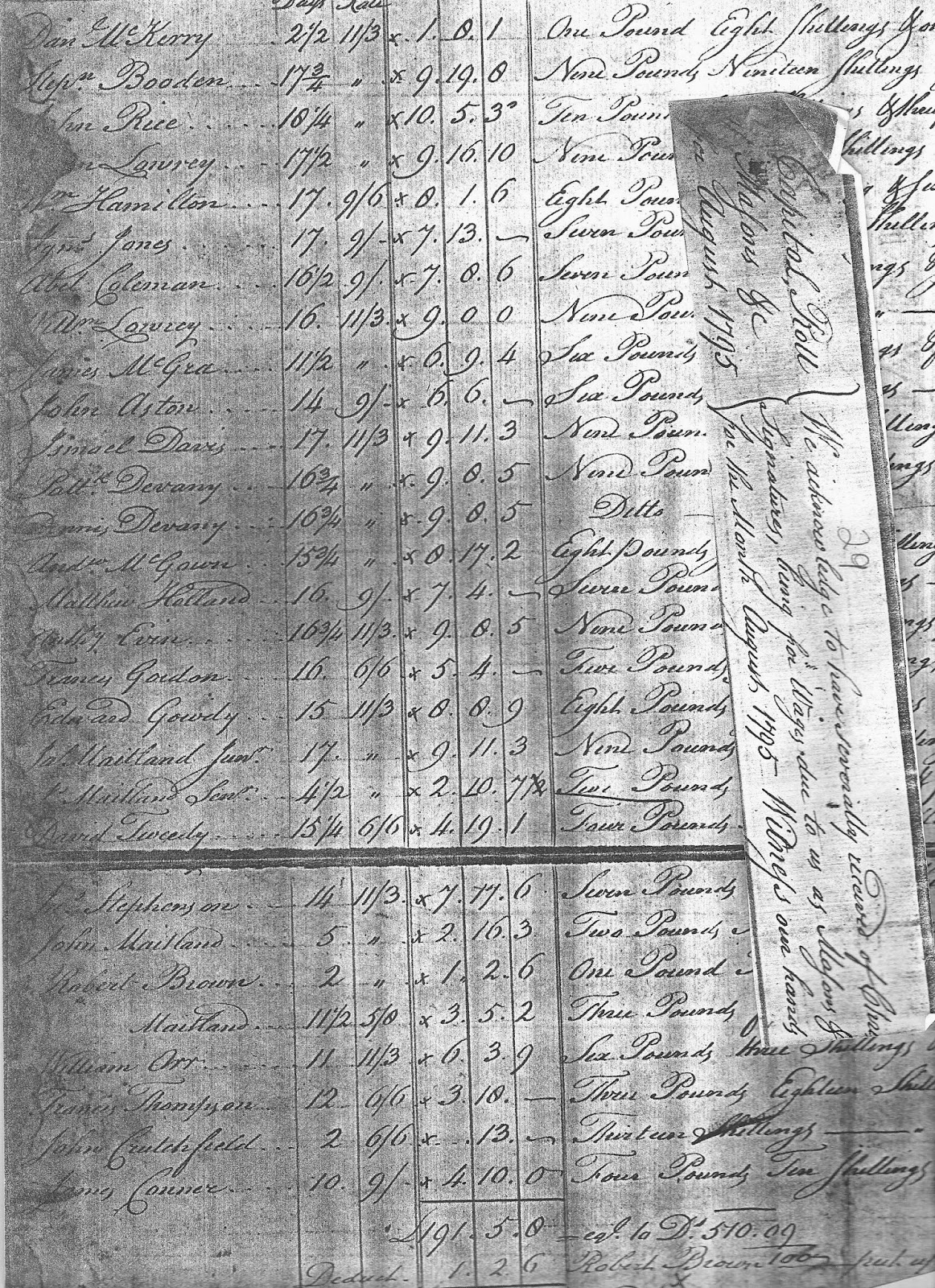
1795 September & August payrolls for stone masons at Capitol

"Criticism from the president and secretary of state prompted the commissioners to question McDermott Roe's masons. As they built their case against him, they also cleared masons who didn't seem involved in the shoddy work. They rehired them to work for wages, not by the piece."

Quote from Slave Labor in the Capital, page 92-3

These payrolls for masons at the Capitol for August & September 1795. They were all white workers, many of them emigrants. The payrolls show men with Irish names who had likely been recruited by McDermott Roe working with men with Scottish names likely recruited by Collen Williamson and his son. The laborers hired by the commissioners, most of them hired slaves, "tended" the masons. That is, they moved the stones from the stone yards after the stone cutters had finished with them to the walls of the buildings and then raised them using cranes, blocks and tackles up the scaffolding, if needs be, so the skilled masons could set the stone. Laborers or in the case of slaves were paid by the month or year. These payrolls for masons show that every man worked for days wages, but the rate, in Maryland shillings, varied from 7/6 to 11/3. I found no explanation for that in the commissioners' records (which doesn't mean none is there.) There are other things in the payroll I can't explain. In September no one worked more than 17 days and in August 18 1/4 days, and several men worked far fewer days. There were some heavy rains in August which may prevented work on the walls.  When compiling my list of men who worked on the public buildings I neglected to include men on this payroll. Only two of the men on this payroll, James Stephenson and James Maitland, were included in the lists in Slave Labor in the Capital's appendix and they were listed not as stone workers but bricklayers. So add to that list of workers a man named Aston whose first name is illegible, William Bishop, Sr and Jr, Patrick Bryan, Abel Colman, James Connor, Israel? Davis, Dennis and Patrick Deveany, Anthony Even or Iven, James Gordon, ? Gowdy, William Hamilton, Matthew Holland, ? and William Lowry, Andrew McGown, James McGrath, and David Tweedy. I print out their names to make searching easier for genealogists. Also interesting is that 6 of the 21 men on the September payroll were evidently related. Bishop Sr. and Jr. earned the same top wage.


Wednesday, January 7, 2015

Hoban's estimates of expenses and use of phrase "Negro carpenters"

In 1796, when Hoban made a list of workers needed to finish the White House, he listed "Negro carpenters..."

Quote from Slave Labor in the Capitol, page 107

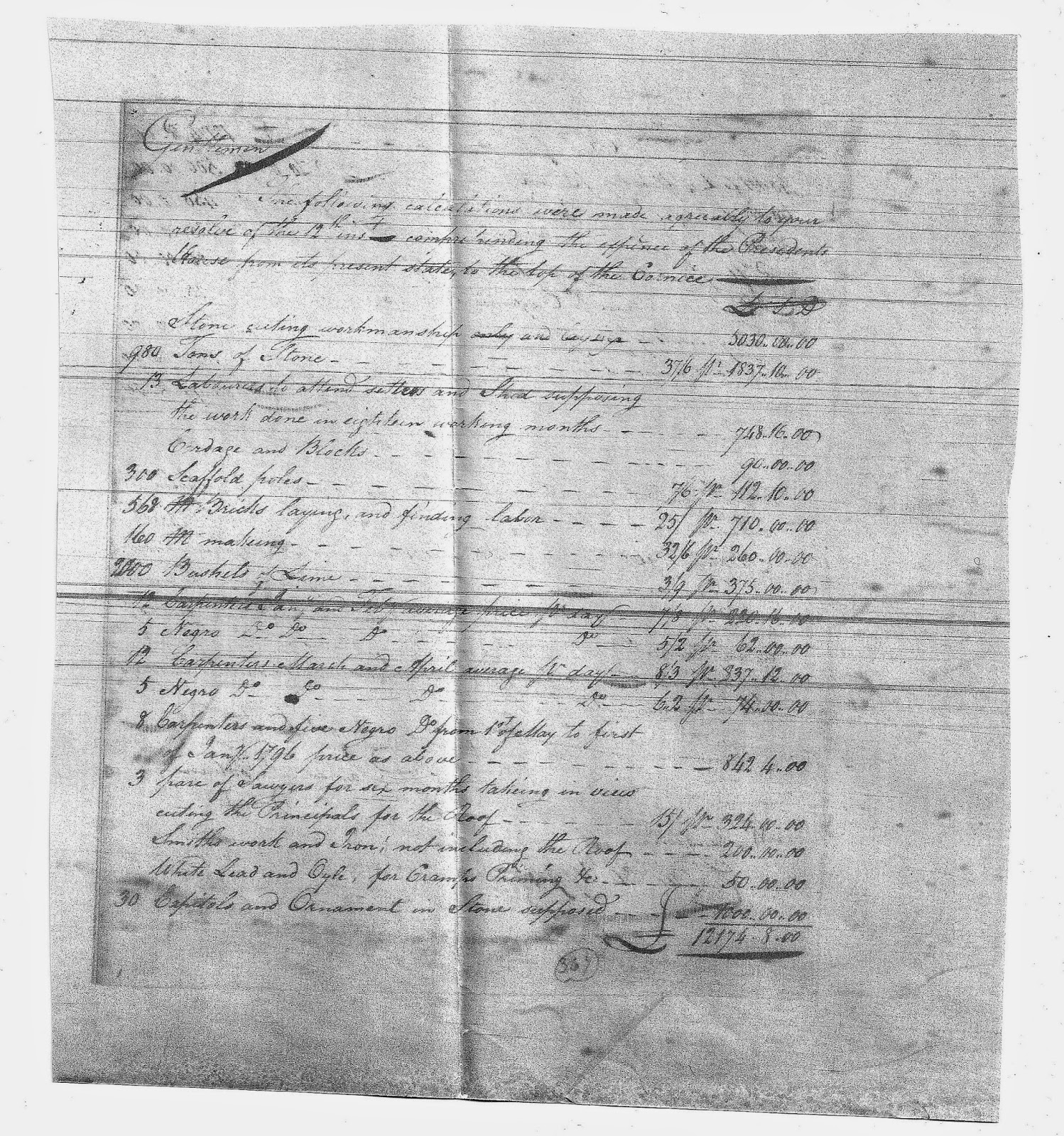
I found two "estimates" written by James Hoban, judging by the hand writing, that both project the use of hired slaves. While it is important to note estimates, we can't assume that those estimates came to pass, especially in regards to slave hire. Both the documents below are long, and both the reduced and original size versions are difficult to read. Circa 1989 the photocopy machines in the Library of Congress were worse than most and all were bad.

The second, and longer, document scanned below estimates the cost "for the hire of 100 Negros" at 22/10/0 a year for each, or, by my calculations, $59.85 a year. The next line estimates the cost of their daily subsistence at 12 pence a day. That meant the annual estimate for slave hire 2250 Pounds was not that much higher than the annual subsistence of 1875 Pounds.

What I also find notable in the second estimate is that the listing of hired slaves comes after the estimate of stone deliveries. In late 1794, slave use in Hoban's mind may have been tied closely to getting the stone from the wharves to the buildings and then up onto the walls. What is also notable is that there is no mention of the monthly hire of slave or free laborers. We know that laborers were hired by the month because they are listed as "monthly hires" in December 1794 payrolls.

I think that by listing the hire of 100 slaves at so cheap a rate, Hoban was making just the kind of hopeful simplification of the work ahead that the commissioners wanted. There would be a large number of tractable and cheap laborers on hand. Actually getting them was another matter. I think I have evidence that when the commissioners wanted to hire 120 slaves in 1798, they hired 90. So I think a rough estimate that 1/4 of the laborers were free (including some free blacks) is a good one.

In the rest of the second document (which consists of two scans sine I had to cut my photocopy of the original in two to get in onto my scanner,) there is no mention of "Negros" when mention is made of stonecutters, or mention of carpentry, sawying, brick laying, etc.

I think the first document the more important one. In it Hoban estimates how much it would cost to raise the White House from its "present state to the top of the cornices." Hoban estimates 13 "laborers" needed to attend the stone setters and "shed." The stone cutters worked in the shed. So here I think he is accepting the reality that some laborers were free. He didn't call them Negroes.

In the rest of the document he does use the word Negro and describes the reality of the work crew as the payrolls from early 1795 show: below the 12 carpenter he lists, he lists 5 Negro carpenters. Those were the slaves he and his foreman at the White House owned. By segregating them he can show that they cost about two shilling less, about 25% less, than free carpenters. Was he presenting an argument for the hire of slave carpenters? If so it fell on deaf ears because in November 1797, the commissioners banned the hire of slave carpenters.

Finally, when he estimated the wages of sawyers, he didn't note "Negro" sawyers even though he had advertised for them and by August 1795 would exclusively use them. This supports the suggestion I make in my book that Hoban came up with the idea of extra wages for hired slaves to do sawing in August. In January he estimated that each pair of sawyers would be paid 15 shillings a day. As it turned out when he started using slave sawyers it cost  him 2 shillings, 25 cents, in extra wages a day for a pair plus the $60 a year or 22 Pounds paid to the master for each slave. He saved a good deal of money by using the hired slaves as sawyers. This suggests that prior to using slaves, he always paid free laborers or used contractors. The free sawyers could have been free blacks and the contractors likely used slaves.


You can get the context for the report in Through a Fiery Trail, chapter 36. Taking a closer look at the document, I realize now that I misdated it in Slave Labor in the Capital. But the point remains. The document shows that Hoban thought of slave carpenters as an integral part of his crew and the commissioners knew it.