How to buy the book
You can order at History Press as well as Amazon, Barnes and Noble and other on-line retailers. I will send you a signed copy for $23, a little extra to cover shipping. I will send you both Slave Labor in the Capital and Through a Fiery Trial for $40. Send a check to me at PO Box 63, Wellesley Island, NY 13640-0063.
My lectures at Sotterley Plantation in St. Mary's County, Maryland, on September 23, 2015, and the DAR Library on December 5 are now blog posts below listed under book talks. The talk I gave at the Politics and Prose Bookstore on February 28, 2015, along with Heather Butts, author African American Medicine in Washington, was taped by the bookstore. Take a listen.
Labels
- axe-men (1)
- book talks (2)
- Brent slaves (1)
- bricklayers (4)
- brickmakers (9)
- carpenters (14)
- carters (6)
- Catholic masters (1)
- commissioners and slaves (23)
- contractors (23)
- corrections (5)
- extra wages (7)
- free blacks (2)
- indentured workers (1)
- James Hoban (13)
- L'Enfant (1)
- labor strife (2)
- laborers (24)
- living conditions (25)
- masons (6)
- masters (12)
- new insights (18)
- overseers (15)
- payrolls (5)
- Plowden slaves (2)
- Potomac canal (3)
- private builders (1)
- quarry workers (6)
- Queen slaves (1)
- rivalries (1)
- sawyers (16)
- servants (4)
- slave bricklayers; US Capitol construction (1)
- slave brickmakers (2)
- slave carpenters (9)
- slave laborers (41)
- slave quarry workers (7)
- speculators (3)
- stone carvers (4)
- stone cutters (11)
- stonecutters (4)
- surveyors (3)
- White House (4)
- Williamson (1)
- working conditions (18)
Showing posts with label living conditions. Show all posts
Saturday, March 19, 2016
1799 description of rooms in the public buildings including apartments for servants
I'm not sure who wrote this December 14, 1799, description of the public buildings that gives the number and dimensions of most rooms inside them. It reminds us that these were not simple buildings easily constructed. Unfortunately, there is no description or characterization of the men who built them nor mention of the architects. Twice the writer points out that in the basements of the buildings their are apartments for servants.
Thursday, March 3, 2016
Tunnicliff's diary.
The Englishman William Tunnicliff and his wife managed a hotel for the Philadelphia speculator John Nicholson. They hoped to make their establishment on 6th near Pennsylvania Ave SE the center of Capitol Hill life. Tunnicliff's ambitious plans were premised on a steady flow of cash and credit from Nicholson. Like Lewis Deblois, William Prentiss and William Lovering, Tunnicliff wrote frequently to Nicholson begging for money, usually in vain.
Tunnicliff had the brilliant idea to send Nicholson what he called portions of his diary that noted every instance of his lacking money to carry on his and Nicholson's business. In these diary entries that are in Nicholson's papers, I did not find the word "slave" or "black." That is not surprising. White people in the 1790s rarely wrote about slaves and blacks in general or as a part of the community.
In 1797 upwards of 90 hired slaves worked on the Capitol and White House. Most of them lived in a log hut camp on Capitol Hill. But they were not a part of Tunnicliff's world. Judging from his diary, he owned two slaves. The diary mentions "our boy Sandy" ordered about by his wife, and "my man Tom."
As the diary shows Tunnicliff was overseeing construction which entailed hiring laborers. Since he paid those men directly for their day's work, they were not slaves. There is no mention of their having masters. Only commissioners had the financial resources to hire a large number of slaves. Nicholson did not give Tunnicliff enough money to finance his operations let alone allow him to hire slaves. As the diary shows, providing bread to workers substituted for actually paying them.
The preferred way to always have someone around who would do the menial tasks that always popped up in a rather inconvenient city was to buy a slave who would do the work and who could be sold when, as I assumed happened in Tunnicliff's case, his Washington dreams ended and he moved north.
In time slave hire in the city would become more sophisticated. Some slaves would hired themselves out. But in 1797 whites like Tunnicliff, Deblois and Lovering who tried to establish themselves in the city bought slaves as servants and to do odd jobs.
(You can find larger images of the letters at the end of the post.)
Monday, February 29, 2016
Were Nicholson's contractors too cash poor to use slaves?
Thanks to his speculator bankruptcy, the papers of the Pennsylvania speculator John Nicholson were preserved. Most of the letters pertaining to his effort to develop his property in Washington are from the men he hired who were desperate for cash to carry on their work. The March 1, 1797, letter below is from William Tunnicliff who ran an inn on 6th St. SE just off Pennsylvania Avenue and tried to develop it and the area around it.
Tunnicliff had a least one slave but this letter suggest that most of his workmen were free. He promises Nicholson that if he does send down some cash "say to amount of 50 Dollars per week will you know go but a little way with the workmen, if I have it, it shall be faithfully distributed amongst them to the best of my Judgement."
Of course, money need not be divvied out to slaves, and it is likely that masters did not hire out their slaves to men like Tunnicliff who, thanks to Nicholson not sending the money he promised, quickly got the reputation for not paying what he owed.
Friday, January 22, 2016
How much plastering did the slaves do?
"Plastering began at the
Capitol in the fall of 1798 as soon as the interior rooms were
bricked and lathed. Work continued through the fall of 1800. The
contractor, John Kearney started with 10 workers.
The commissioners ordered him to hire more and gave him 3 more hired
slaves to help. On average, 4 or 5 of them worked with the
plasterers, amounting to 65 ½ months of work. Here too the
commissioners charged the contractor $16 a month for the hands. We
don’t know exactly what the hired slaves did save that in June 1799
the commissioners ordered a ½ pint of whiskey a
day for the slaves boiling plaster of Paris."
Quote from Slave Labor in the Capital, page 148
We do not have the payrolls of the contractors so we don't know how many slaves they used, if any, unless, as in the case of Kearney, they hired slaves from the commissioners. We know that slaves worked as plasterers. Clotworthy Stephenson, an associate of James Hoban, who lived near the White House noted that his runaway slave Will was both a bricklayer and plasterer.
While I found little information on Kearney, there was another contractor who came to the city in 1796 to do plastering, Hugh Densley. He contracted with Robert Morris and John Nicholson to plaster the houses the speculators were having built mostly in southwest Washington. The speculators arranged for Densley to rent 21 "temporary buildings". He would pay the rent with plasterers' work.
There were different rents for the "temporary buildings," varying from $12.16 to $60.76. How the rents for temporary structures likely made with wood could vary so much is puzzling, probably had to do with floor space.
I share this document from Nicholson's papers for two reasons. It shows the scale of Morris's and Nicholson's operations and shows that skilled workers had to be housed some likely with their families. I think it more likely that Densley recruited free workers from Baltimore or other cities to come to work for him, rather than recruiting slaves from area masters. Both free and slave workers had to be housed but slaves could be forced to sleep in spaces that would have cost Densley far less money. I should add that the bankruptcies of Morris and Nicholson probably stymied the fulfillment of the bargain described in the letter. The whole story might be found in Nicholson's papers.
Saturday, January 2, 2016
Assessment of Improved Property in 1803
"At the end of the month 7
free workers were hired, including Ambrose
Moriarty.
In 1799 Moriarty wrote
a letter to the commissioners saying he wanted to buy a building lot.
He introduced himself by saying "I have formerly been employed
in attending masons and other work for the public." He did buy a
lot and was on the city’s 1803 tax roll."
Quote from Slave Labor in the Capital, page 97
In 1803 Moriarty owned an improved lot on Square 432 assessed for $1000. He obviously didn't rely entirely on his wages as a laborer to accomplish that. I don't know where I found this list back in 1990, or who compiled it. What is also interesting in the context of my book on the use of slaves is how few masters who hired out slaves are on the list. Most of those few on the list were also contractors or employees doing work for the commissioners like Samuel Smallwood and Bennett Fenwick.
The exception was Ignatius Boone who owned property in square 907 valued at $1100 hired out at least 4 slaves, Charles, Jacob, Lewis and Moses. My guess is that he moved to the city after he hired out the slaves, not while he did.
Tuesday, December 29, 2015
Small pox in the city and the hired slaves
When the brick-making
contractor John Mitchell heard that Bennett Fenwick, whose slaves dug
clay, was planning to “bring smallpox to the city” and inoculate
members of his family, the commissioners’ hired slaves soon knew
about it. A group of them approached the commissioners and asked to
be inoculated against smallpox. The commissioners sent ten
of them to the hospital and deducted the doctor’s fee for those
inoculations from the wages sent to the slaves’ masters. We know
the inoculation of “Negro Emmanuel” who worked at the Capitol
cost his master Alexander Scott seventeen
shillings and six pence. But the commissioners did suffer a
loss. It took a patient several days to recover from inoculation,
and that year, the commissioners had
promised masters not to deduct wages for time not on the job if
their slave was sick.
Quote from Slave Labor in the Capital, page 139
The commissioners described the slaves who asked to be inoculated as "Slye's labourers." Slye was the overseer at the Capitol.
The note to Dr. Crocker, of which I don't have a copy to scan, made clear that the slaves asked for the inoculation. It was at "their request." A month after the March 5, 1795,
order to Crocker, he was replaced on April 27 by Dr. Brown who
was to get "$1.33 per head for all laborers engaged in
public employment." In September 1795 the commissioners paid Dr. Brown
$21 for inoculating laborers.
However, the commissioners made some sacrifice since
inoculation entailed preparing the patient with medicine in hopes
that when he was exposed to smallpox he would have an easy course
of the disease, and, of course, while he was sick, he had to
remain in isolation. The
commissioners didn't penalize the master for the time the slave
might have been in isolation. In their 1796 newspaper
advertisement soliciting "120 good laborers", the
commissioners offered masters $60 for the year, a place for the slave to lay his blanket, rations,
and "attendance by a physician and no deduction for
sickness."
The receipt below was made out to laborer Thomas Dixon whose slave Will was inoculated in 1797 at a cost to Dixon of $3.
Below that there is a 1795 letter to speculator/developer John Nicholson. In the second page his manager explains that work will be delayed 6 weeks because his joiners had to be inoculated.
Thursday, December 17, 2015
Gardens for workers?
I dedicated Slave Labor in the Capital to "Leslie's vegetables." I wrote much of the final manuscript in our cabin in the woods and while I wrote, she tended the gardens nearby. I had fresh lettuce, peas, green beans, beet greens, and lima beans and tomatoes as summer wore on. Despite working in an expanse of fertile land, the hired slaves and other workers subsisted on what amounted to sea rations, salted meats and Indian meal.
I think as they worked from dawn to dusk, as much as freedom the hired slaves yearned for garden vegetables. Freedom was an impossibility but not vegetables. The overseer of labors who got the same meals as the slaves protested http://capitalslaves.blogspot.com/2014/11/overseer-smallwood-complains-about-meals.html
But he could ask for higher wages and could buy vegetables. Slaves had no spending money. In his 1792 description of the labor force and its needs, L'Enfant recognized the need for workers gardens even as he planned for more varied rations.
In 1794 with the prospect of the supposed wealthy speculators Greenleaf, Morris and Nicholson promising annuals payments and loans to the commissioners, the commissioners looked to expand their operations but were still mindful of trying to control their labor costs. As Greenleaf prepared to go to Holland to package loans for the syndicate and the commissioners, the commissioners asked him to get indentured stone cutters for the city as well as common labors. Then they sent another letter with a second thought. Stone cutters might want to bring their families in which case the commissioners thought they and the syndicate should designate a portion of the thousands of undeveloped lots as an area for "garden grounds" northeast of Massachusetts Avenue. Nothing came of this, no indentured stone cutters came and as the letter suggests no sooner did the commissioners think it proper to accommodate families, then they suggested to Greenleaf that they really preferred single men.
As far as I know, none of the men working for them were offered "garden grounds." The commissioners knew they needed workers but didn't want them to grow comfortable in a city to be peopled with the gentlemen who would lead the country.
Thursday, December 3, 2015
Proof that L'Enfant did not hire slaves
"He didn't hire any slaves."
Quote from Slave Labor in the Capital, page 38
In September 1791 the commissioners authorize L'Enfant and Ellicott to hire 150 laborers. They managed to hired 75. There is no evidence that any of them were hired slaves. After those laborers were fired, the commissioners resolved to hire slave laborers. They would not make such a pointed resolution if they had already hired slaves. In the first document below, a letter to L'Enfant and Ellicott, the commissioners express their disappointment that 150 laborers were not hired. They worried that more "hands" were needed to get the city ready for an auction of lots in a few weeks. All three commissioners were slave owners, but they don't suggest the hiring of slaves. They suggest offering higher wages, "an advance price for a fortnight or a month."
The commissioners fired all the workers hired in early January. Letters generated by that, also copied below, give more evidence that none of the hands hired were slaves,
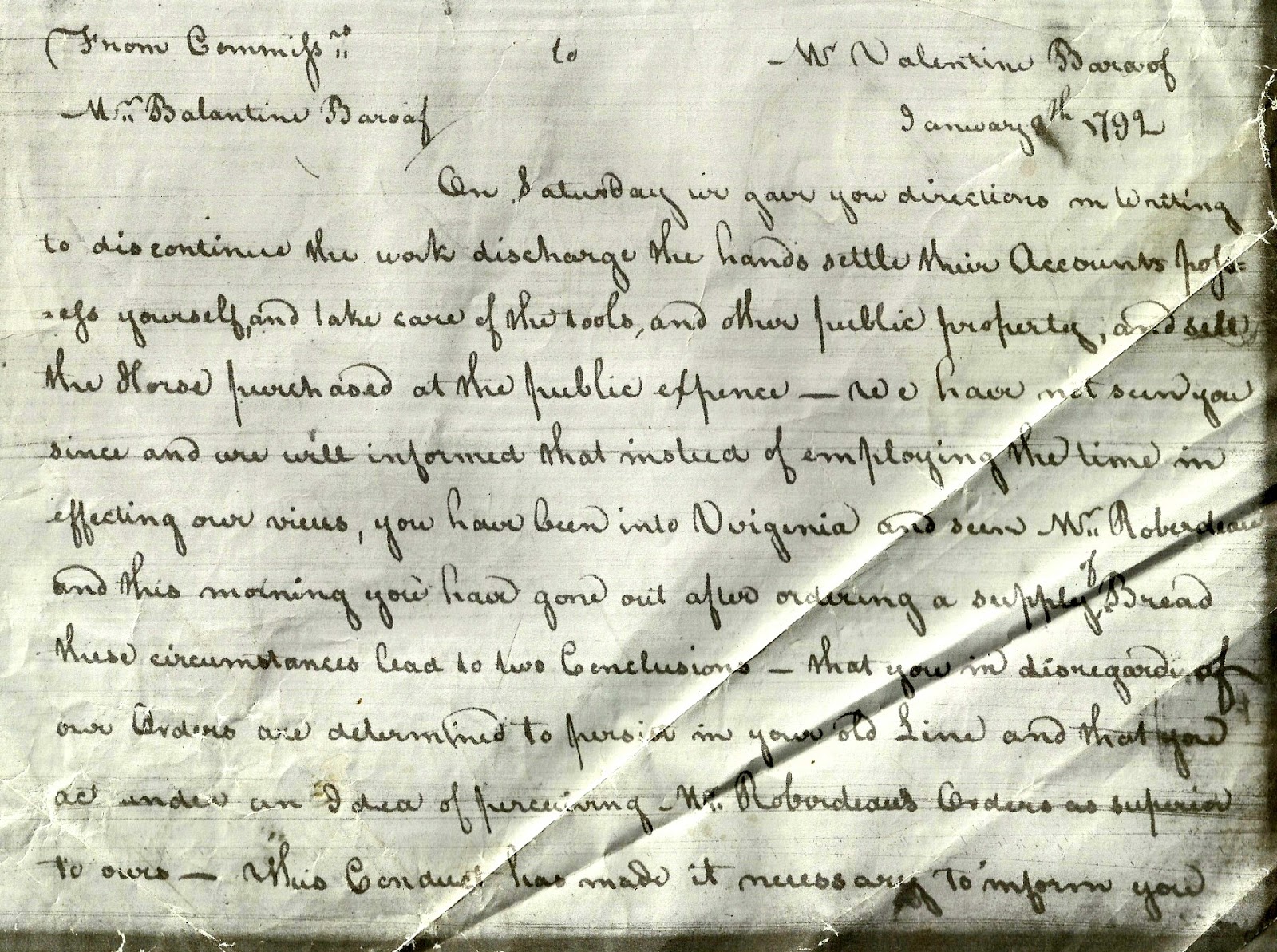
The commissioners January 9, 1792, letter to Valentine Boraff, the commissary hired to feed the workers, clearly shows that the workers L'Enfant hired were not slaves. In the first sentence of the letter below the commissioners note that they had ordered Boraff to "discharge the hands settle their Accounts...." The commissioners never set up an account with a slave. All the money earned by all of the slaves that they subsequently hired went to the slave's master.
Below that letter I add two letters from Boraff as he tried to adjust to his dismissal and get reimbursed for money he had advanced for the work including $30 for a horse he bought because he had to ride so often to Georgetown to get supplies. He worked for 179 days for $1 a day. He wrote the second letter to Roberdeau who after being fired conspired with several Georgetown speculators to continue to pay the fired laborers. Roberdeau left the city leaving Boraff to deal with the laborers when he could not pay them. This is another indication that none of the laborers were slaves since once dismissed their masters would be obliged to care for them.
Finally there is a receipt reimbursing Roberdeau for feeding the fired laborers until January 21. I think Roberdeau reimbursed Boraff back in 1792.
Subscribe to:
Posts (Atom)