How to buy the book

You can order at History Press as well as Amazon, Barnes and Noble and other on-line retailers. I will send you a signed copy for $23, a little extra to cover shipping. I will send you both Slave Labor in the Capital and Through a Fiery Trial for $40. Send a check to me at PO Box 63, Wellesley Island, NY 13640-0063.

My lectures at Sotterley Plantation in St. Mary's County, Maryland, on September 23, 2015, and the DAR Library on December 5 are now blog posts below listed under book talks. The talk I gave
at the Politics and Prose Bookstore on February 28, 2015, along with Heather Butts, author African American Medicine in Washington, was taped by the bookstore. Take a listen.
Showing posts with label payrolls. Show all posts

Saturday, February 14, 2015

Free laborers and slaves hired by the month

The laborers hired by the year, principally slaves, were evidently not kept on payrolls. Their wage did not vary unless they were absent for over a week. As these 1796 payrolls for overseers and laborers show, overseers and free laborers were on payrolls and during the building season monthly hires, usually more free laborers than slaves, were added to the payrolls.

The March 1796 payroll lists three overseers, including John S. Slye, who was hired by the commissioners as a reward for bringing 30 hired slaves to the city. Obviously those slaves, paid by the year, are not on this monthly payroll. One of the two laborers on the payroll, Jeremiah Holland, was, I think, the laborer referred to in a 1795 note as "Jerry the black man." 


The April payroll is as spare as the one in March and Slye is not on it. My guess is that he left or was fired.


I copied the July and August 1796 payrolls for overseers and laborers which shows how the number of laborers swelled. Also two new overseers are listed: William White and Samuel Smallwood. The July payroll shows that laborers got a raise in the middle of the month from 60 Maryland shillings a month to 75. However in the spring of 1797 they would again make 60 shillings a month so the raise was probably an inducement to continue working during the hot months.

These payrolls do not segregate the free laborers paid by the month from the slaves. Although members of the same family did work together, usually men with the same second name listed together were slaves and that the last name they shared is the last name of the master. Unfortuntely,  many of the payrolls were bigger than the photocopy machine at the Archives so I did not always include the signature of the person who received the monthly wages.

In my book I list hired slaves, masters, black laborers and white laborers so there you can find my ideas on the status of all the men on these payrolls. Below the 1796 payrolls, I show a scanned photocopy of a May 1797 payroll showing how a master or his agent signed for the receipt of his slaves' wages. The two men listed with Burnes as the last name were slaves of James Burnes.


Sunday, December 21, 2014

Ignoring a slave's last name

"Likely many of the slaves had both a first and last name, but only one hired slave was ever listed with both names in the commissioners' records."

Quote from Slave Labor in the Capital, page 26.

On page 72 of my book I briefly tell how the master of a slave named Jack Fuller was desperate to get the money due to him for hiring out his slave. Save for the only woman slave hired, Catherine Green, none of the slaves listed in the commissioners' record was given a last name. Even when slaves were on payrolls for extra wages that they kept themselves, they were listed with one name and usually without their master's last name also noted.


Other slaves were named Harry, Dick, Moses and Charles so last names might have been helpful. Maybe none of the slaves had a last name, but in the one letter I found written to the commissioners or their employees about a hired slave, the slave's master used the slave's last name. As you see below, the master John Linton made a point to refer to his slave by his full name, Jack Fuller.
 

In a receipt in which the commissioners reimbursed Robert Brent, a manager at the quarry, for paying John Linton, Jack Fuller is listed as "Negro Jack."


Sunday, November 23, 2014

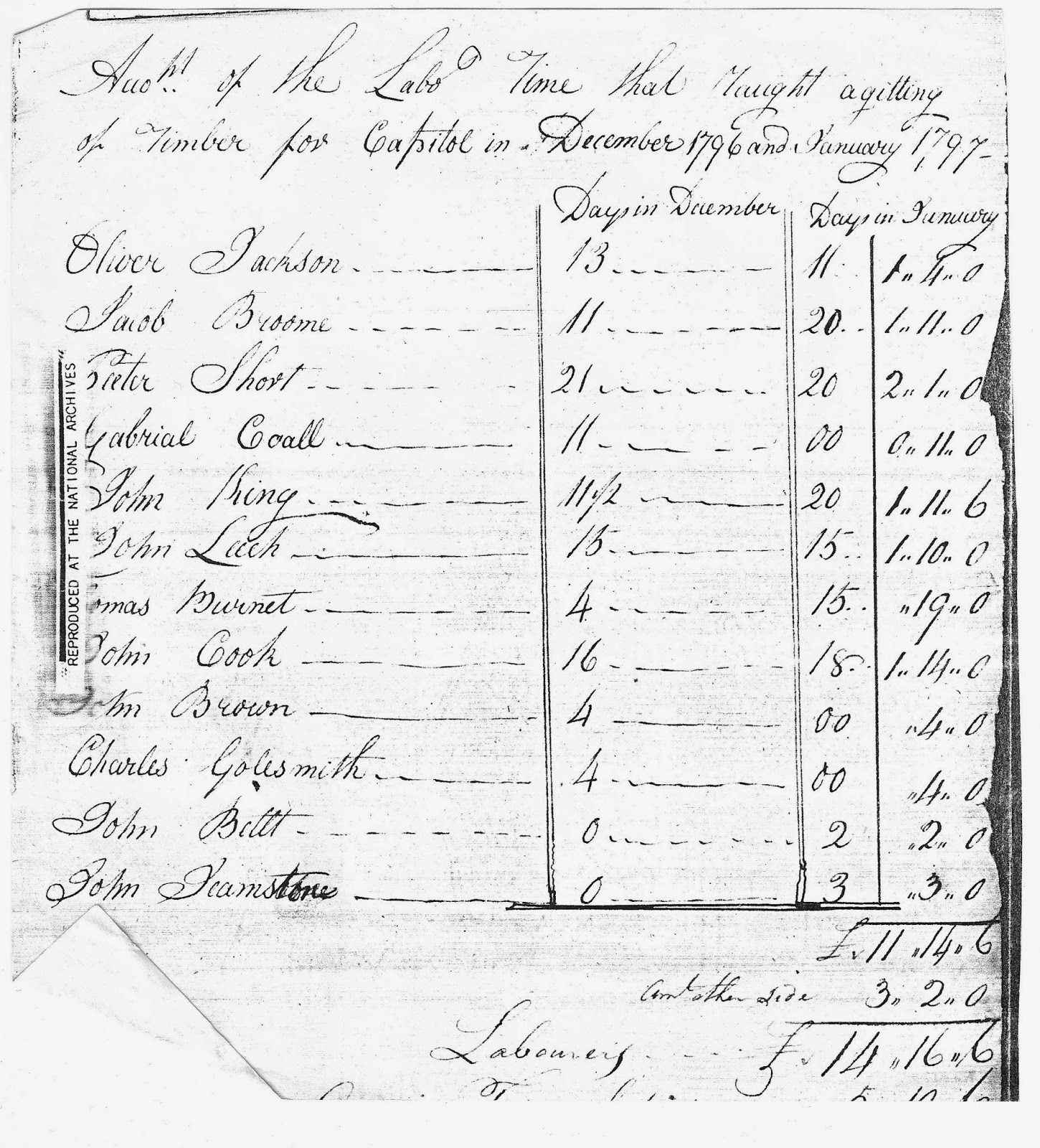
Payroll for Extra Wages December 1796-January 1797

"The point is that a large group of slaves with long saws, broadaxes and felling axes... got the job done."
Quote from Slave Labor in the Capital, page 63


This image is from a photocopy of the account of the days worked and wages earned by the hired slaves, one free black, their overseer, and the carpenter in charge of the expedition to Paint Branch, a tributary of the Eastern Branch, as the Anacostia River was generally called then, to cut the white oaks needed for timber for the White House roof. This was a rushed job. The commissioners contacted the land owner Walter Bowie on "31st (sic) November." Their men were cutting the white oaks two weeks later.


The usually the pace of work slackened before Christmas, especially for laborers. Perhaps because of that all the men who went to cut the wood were paid an extra wage of a shilling a day. In the payroll above, the hired slaves are noted as either sawyers or laborers. By this time sawyers customarily received a shilling a day in extra wages. Laborers rarely did.

That the slaves kept their extra wages is indicated by the absence of their master's name save for when slaves with the same name had to be distinguished, e.g. one Charles listed belonged to a man named Goldsmith, the other to a man named Rentzell. That Jacob Butler is a free worker is suggested by the lack of a comma between Jacob and Butler and other records. The shilling a day he received evidently supplement his usual day wage of 3 shillings.

The variation in the number of days worked probably reflects the need for some slaves to return to plantations relatively far away.

The circled number "59" notes that I used this information in Chapter 59 of my book Through a Fiery Trial."cutting wood" written on top of document is also my writing. I've long expected the National Archives to share these documents on-line. Until then you'll have to bear with my notes.

At the same time another crew cut white oaks for timbers for the Capitol's roof. Judging from the payrolls there were several free laborers in this crews. Slaves were often listed by their first name immediately followed by the name of their master, but most of the men below were free and judging from what I could glean from genealogy websites most were white. According to this payroll, they also got 1 shilling a day which I find confusing. I hope it supplemented the monthly wage they received but I have not found a payroll showing that. It was likely difficult for laborers to find work at this time of year which might have made even a shilling a day, salt meat, bread, and a special ration of brandy attractive for free workers.


The one man in the above list who was probably a hired slave was Charles Golesmith, that is, Golemith's [Goldsmith's] slave Charles. A separate payroll listed 6 men who were hired slaves. Jerry was owned by Susannah Mills, Jacob by James Stone, Orston by Bennett Fenwick, Toney by Edward Plowden, Richard by Bennett Barber and James by Thomas Bond. Not that those master's names were added because they collected the wages. The shilling a day went to the slaves. The overseer, Samuel Smallwood, listed his own daily wage, 2 1/2 shillings on the bottom of the payroll.

Payrolls for Capitol Bricklayers, March & May 1797

"A full-time free bricklayer had a network of other bricklayers he could tap."

 Quote from Slave Labor in the Capital, page 127

This a payroll for bricklayers.  In photocopying the payroll I cut off the top line. Pardon me for not getting this payroll reproduced properly but I am one unfunded man, not the National Archives which should be doing this. Years ago I circled the date on the photocopy I made to remind myself that this payroll was for half the month of March. The number "62" refers to the chapter in Through a Fiery Trial where I make reference to this payroll.


One historian has suggested that slaves hired by contractors did most if  not all of the bricklaying at the Capitol. This payroll suggests otherwise. I've been unable to find any evidence that any of the men on the payroll were free blacks. Patrick Farrell who signed the payroll was himself a bricklayer and in this instance acting as a contractor. One of the bricklayers he hired, Allen Wiley or Wyley, also contracted with the commissioners for bricklaying, but on a piece-work basis. Farrell paid his men wages by the day.

Another payroll from May 1797 shows that the bricklayers and masons got a raise from 10/6 a day to 11/3. However, only two of the men listed worked most of the month.


My guess is that the sporadic number of days works meant that the bricklayers at this time depended on the stone laying of the masons. Bricks were used to back up the stone work. Allen Wyley is the man missing in the May payroll. At some point he became a contractor working on a piece-work basis.

A letter Patrick Farrell wrote to the commissioners at the end of May shows that there was a power struggle over control of the bricklaying. The hired slaves are not mentioned in the letter:

26 may 1797,

Gentlemen, from my first Commencement in Business until my Conducting and Superintending the Brick and Rough stone work of the Capitol, being recommended by Capt. Hoban who had a Knowledge of my ability, always made it a Rule to act perfectly conformable to my Employer in a most Just and honest manner. But by which reasons I have incurred the displeasure and indignation of Mr. Hadfield, I solemnly declare I know not. Notwithstanding have experienced from him repeatedly the most insulting and ----- language and abuse in the presence of the tradesmen that could be given to any man of the least decency - declared in particular that he would break all the bones in my skin, without giving him the least provocation. Mr. Hadfield told me in presence of the Bricklayers and I adjusting their work that if I had less Activity I should be better liked and that my activity was well noticed he likewise said some time that I was kept on employment for mere charity. However his conduct and --- on the whole I pray may be discussed by the Honl Board and by the Principal tradesmen of the building that can inform ye of my conduct and behavior since my commencement. His insults and affronts on me hav caused the men to take liberty that is hurtful to the building. Making it my constant study to act for the publick good and pleasing to your Honrs to whom I prefer the whole to be regulated and adjusted as ye shall judge most consistent. As Mr. Hadfield has publickly declared I shall be discharged from this employment, these matters only could induce me to trouble you Hope for your candid decision as soon as you shall think convenient which will be most gratefully acknowledged by your....

Patrick Farrell

 p.s. Mr. Hadfield never detected me in on error, tho he well knows there has been a great many, but his delicacy forbids him to tell who was guilty of them - I am despised by the architects and reprobated by the two employers for doing my duty. But now expect to have a free trade 

Thursday, November 20, 2014

Payroll for Capitol Stone Cutters August 1795

"could not muster a force sufficient without putting an entire stop to the setting."
Quote from Slave Labor in the Capitol, page 94. 

While there is no evidence that hired slaves did any of the skilled stone work on the Capitol and White House, we can get a sense of what the slaves were doing from payrolls of skilled stone workers because the hired laborers, mostly slaves, moved the stone.

Stonecutters were the key workers in the construction of any stone building so it is strange that in August 1795 only 7 were working at the Capitol:


Most likely some of the stonecutters were working on the Capitol walls as masons. Blagden wrote a note to the commissioners explaining that he delayed some stone cutting work because the laborers he would need to move the stone were working so well with the masons raising the walls.

This payroll like several others for May through August shows workers at the job for more working days than there are in the month. Blagden and Waterstone worked 30 days and August has 31 days. I interpret this as meaning that rather than working on Sundays, they were credited for working longer summer daylight hours. If they had worked on Sunday slaves who assisted them would be entitled to extra wages of at least a shilling a day.

Four of the stone cutters evidently got a raise during the month, from 11 shillings a day to 13. George Bladgen got twice the common was for stonecutters. In August he earned 41 Pounds 5 shillings or about $110. The highest salaried worker, James Hoban, earned $1500 a year and the commissioners $1600. Masters who hired out slaves got $60 to $72 a year. There is no evidence that slaves tending stonecutters and masons ever got extra wages they could keep themselves.