How to buy the book

You can order at History Press as well as Amazon, Barnes and Noble and other on-line retailers. I will send you a signed copy for $23, a little extra to cover shipping. I will send you both Slave Labor in the Capital and Through a Fiery Trial for $40. Send a check to me at PO Box 63, Wellesley Island, NY 13640-0063.

My lectures at Sotterley Plantation in St. Mary's County, Maryland, on September 23, 2015, and the DAR Library on December 5 are now blog posts below listed under book talks. The talk I gave
at the Politics and Prose Bookstore on February 28, 2015, along with Heather Butts, author African American Medicine in Washington, was taped by the bookstore. Take a listen.
Showing posts with label new insights. Show all posts

Monday, February 15, 2016

Hire Negroe from public Works

That title is not a typo. It should not read "hire negroe for the public works." My book is about how the federal government hired slave laborers to help build the Capitol and White House, but here a slave is hired from the government. In the commissioners' records there are rarely explanations of their policy, so we are left with interpreting the meaning of documents that contain the word "Negro" which was synonymous with slave. 

The commissioners made no secret of their desire to find skilled workers who would accept a lower wage and they favored using contractors in order to lower costs. Dobson was a British stone mason who promised to provide a crew of English masons who would accept a lower wage. The commissioners signed a contract with him more or less like the one they signed with an Irishman, Cornelius McDermott Roe who promised them lower wage Irish masons. Both contractors were paid by piece, i.e. based on how much stone was laid on the Capitol walls, so we don't know what they paid their masons.

It took more that skilled masons to build a wall. They needed tending. The commissioners thought they had the best way to keep the demands of those laborers in check. They hired slaves who had no motive for demanding higher wages.

Contractors were not as successful as the commissioners when it came to hiring slaves. The contractors were creatures of the commissioners' needs, with no record of prior successes. Slave masters trusted the federal government to pay them but not immigrant contractors. By the way, the work of slaves was always paid for after it was done, the same as for free workers.

So the contractors flattered the commissioners by asking them to provide the laborers needed to tend masons. The commissioners also hired free laborers, mostly white and a few free blacks, but the contractors made a point of asking for slave laborers. Evidence for that comes from a comment in a letter written by the disgruntled former head of stone operations, Collen Williamson. That he was disgruntled casts doubt on all he wrote so the note below showing Dobson hiring a slave is significant.

The receipt also has the line "hire stone cutters." I found a payroll listing who those stone cutters were and what they were paid for their work in September 1795. I seem to be the only person interested in these details and I am too old and live too faraway to dig into the records and try to figure who those men were. But I share their names because is underscores the difference between a skilled worker and a slave. The former made as much as 13 pounds 15 shillings for a month's work, about $36. The slave who had been working since January, made $40 for his master. Yet, the slave's labor was just as necessary.


Tuesday, January 19, 2016

Where did the slaves' masters live?

The letters of the commissioners are mum when it comes to slave hire. This all happened well before the era when governments constantly studied themselves to make the bureaucracy more efficient. There was hardly any bureaucracy: three commissioners told one man to hire slaves. So in their records, there is not even a hint at why almost a third of the slaves hired came from such a distance.
Quote from Slave Labor in the Capital, page 28

While the commissioners didn't write letters discussing slaves they hired, there are receipts in the records and also a few letters from masters authorizing others to collect the wages of their slaves. When I did my research, I didn't copy those letters since generally payrolls had that information. Of course now I wish I had copied everything.

Fortunately, others have shared copies. The images below were taken from the US Capitol Historical Society website: http://www.uschs.org/exhibit/exhibit-freedoms-shadow/dchc_00.htm

Valuable as it is, the website, in my opinion, doesn't quite milk the documents for all their significance. The documents suggest how far away the masters lived. The first receipt below is signed by Middleton Belt for his own slave, Peter, hired out to the commissioners.


Belt was a contractor who did hauling for the commissioners, and lived, I am pretty sure, in Georgetown. Another master Joseph Forrest signed for his slaves.


His brother Uriah was a prominent Georgetown landowner. Henry Turner collected the money for his father Joseph's slaves.


Was Turner another Georgetown resident who just sent his son over to collect the money?

Other receipts show that some masters lived far away. Valentine Reintzell wrote from Chaptico, Maryland, about 50 miles down river on the border of Charles and St. Mary's counties authorizing Zephaniah King to collect the money.


King in turn wrote authorizing Matthew Kennedy.

The next receipt for James Hollingshead who hired out Abram and Charles shows that James H. Blake collected the money that the two slaves earned for Hollingshead. Blake also collected the money for slaves hired out by Susannah Johnson and Francis Wolf. Hollingshead later became an overseer of the laborers at the Capitol. So he was not rich master. But James Blake was a man of some repute.


James Blake became the mayor of Washington, appointed by President James Madison. Blake had strong Virginia connections and lived there before moving back to Washington to become mayor, or so my spotty research suggests. Most of the slaves hired to work on the public buildings came from Maryland. There was a common law tradition restricting hiring out slaves in another state for over a year, but I wonder if Blake might have been a middleman who eased Virginia masters' fears and brought their slaves to Washington.

Another receipt shows Thomas Baden collecting the money for James Stone


And here is an interesting letter I missed, from Stone to the commissioner's clerk, Thomas Johnson, Jr., authorizing Baden to collect the money (though Stone seems to misspell Baden's name.) I'm kicking myself for missing this letter, which was available on-line well before I wrote my book, because of this phrase Stone used, asking for the money for "my Peoples labor in the Public Service."


In my research, I have found "people" used to refer to both a gentleman's staff of servants and to a contractor's employees. It did not necessarily have racial overtones as in the spiritual "Let my People Go." In this case, it clearly refers to black slaves. Yet, of course, when the Founders wrote "We the People of the United States..." in the Constitution, they were not thinking of their slaves.

Tuesday, January 12, 2016

Original receipt for slave sawyers' extra wages

The National Archives and the U.S. Capitol Historical Society have put photographs of work records relating to the hired slaves on-line. Thanks to the photocopies I took in the Archives in 1989-90, I have scanned far more records, but those institutions certainly do a better job. (I tried to get down to the Archives to photograph records while writing Slave Labor in the Capitol but the Archives claimed they didn't know where the records are!) The trouble with my photocopies is that to save money I tried to copy two payrolls at a time and I made notes on the photocopies. The images below, provided by the USCH, show the true current state of the records.

I have this image in another post http://capitalslaves.blogspot.com/2015/03/payrolls-showing-extra-wages-for-slave.html

but after posting that I've been going through my records again and noticed that there is a folder for the document that clearly labels the pay as "Extra wages." It also shows that the money was paid out on September 5, 1795, just 6 days after the payroll was signed by the foreman of the carpentry work at the Capitol. In general hired laborers or their masters were only paid every quarter, every three months. September 30 would be their payday for work done since June. The slave sawyers were treated just as skilled workers were, paid every month.

In my book I was careful not to exaggerate the contributions of slaves just I was careful not to exaggerate the talents of white skilled workers. The slave laborers paid extra wages to do sawing are the heroes of my book. That said, I don't think it right to call them skilled workers. That label belongs to the traditional building trades, but I don't think we should downplay the fact that slave sawyers were paid after a month's work like skilled laborers.

Examining the payroll below, probably for the hundredth time, I think I learned something new. In most of the payrolls for sawyers, the mark "x" at the end of the line listing their days worked and rate of pay (always 1 shilling), all look the same. In the payroll below it is noted that the receipt of money was "witness our hands" but there are not the usual x's. I just realized that the marks in front of the name might be how the slaves witnessed the receipt of their wages. Are their marks an attempt to write the first letter of their name? If so, it's the only example I've seen. Payrolls with illiterate free laborers or slaves getting extra wages used the traditional legal formula of "X his mark." Unfortunately the right side of the document is damaged but I don't think there is enough room for the usual "X his mark."


Saturday, December 19, 2015

Taking a larger view of the slave labor used

As I explain in the book, the commissioners generally thought they could save money by contracting out for supplies. Brick contractors worked so close to the Capitol and White House that I do discuss the slaves used by them, though I have no sure numbers on how many slaves as opposed to free workers, including free blacks, were used. In describing how the hired slaves got roof timbers for the building in the winter of 1796-97, I make clear that it was a special job. The commissioners had contracted with outside and far away men, presumably plantation owners, for most of the lumber needs.

That means a full accounting of what the slaves did is impossible without the records of those contractors. I had begun researching that on the web but didn't put what little I gleaned in the book. The letter below shows again what I often suggest in the book, the mere contracting for something or advertising for work and slaves does not reflect what really happened. Someone has to dig into the commissioners' account books to see if McCarthy Fitzhugh, Esq., ever delivered the timbers.

Who was he and did he use slave labor? There is a court case listed in Cranch's Reports, volume 1, about McCarthy Fitzhugh not paying $55 for annual hire of "Negro Charles" in 1797, nor the penalty agreed to if he didn't pay. The 1804 case was in the District of Columbia, which then included parts of nearby Virginia. But the contract the commissioners made was probably for timber in the Northern Neck. The Fitzhugh plantations had long been near the Lee plantations and genealogical records show that is where Henry Alexander Ashton lived.

I don't think the court case has anything to do with the timber contract other than showing that McCarthy Fitzhugh was not meeting his obligations in 1797. Judging from other court records "Negro Charles" was a man servant bequeathed to male family members until they reached the age of 21.

Slavery permeated Virginia society and the question is did Fitzhugh also hire slaves to get timber just as William Augustine Washington did on the commissioners' account http://capitalslaves.blogspot.com/2015/11/hring-slaves-to-cut-timber-in.html, or did he use his own  slaves?

My guess is that slaves were hired to do that work and one would think that somewhere there remain records of that hiring. Find that and we get a more complete idea of  how many black hands built the White House.


Tuesday, December 15, 2015

"to his little Negroes who carried them away in baskets...."

"Thomas Middleton, an English cabinet maker living on the President’s Square had both a little “yellow girl” and “Negro Jack” to make his life easier."

We know about Middleton's slaves because they were accused of stealing for their master, but in my book I didn't get into that. Much more important was to show how easily emigrant workers adapted to slavery. 

In the winter of 1798-99 work began in earnest on the interiors of the Capitol and White House. While it would seem there was plenty of work for everyone, the Irish coterie around Hoban looked with alarm as Joseph Middleton, an English carpenter and joiner, set himself up in a temporary house on the White House grounds. They accused him of using public materials for furniture and fittings he did for private houses.

The commissioners investigated by calling witnesses. In the letter below Commissioner Alexander White, a lawyer, summarized their findings in a letter he sent to his colleagues. Here is an abbreviated transcription of the letter.

...because it is in proof before the commissioners, that a variety of cabinet work and some carpenters work have been done in Mr.Middleton's shop while he was receiving daily pay from the public, some part of which by Middleton himself and other parts by his journeyman and apprentices... That he saw Middleton's yellow Girl carry 2 x 2 1/2 inch plank about two and two and an half feet long out of the shop when Middleton was in it..... he saw Middleton hand down from the President's house 1 1/2 or 1 1/4 inch plank about 2 1/2 feet long to his little Negroes who carried them away in two baskets... He saw mahogany chairs and tables carried from the President's house after sunset by Middleton's apprentices.... Then on Friday and Saturday before Christmas he saw Middleton's Negro man Jacob carrying public stuff out of the yard....
By the way, in this letter the "Negro man" is called Jacob. There are other letters about this from which I got the name Jack.
 
The investigations of the commissioners preserved documents I find useful, but I can't help but wonder why the three of them wasted so much time investigating the theft of building materials and did not simply arrange for a better guard or stricter accounting. There obviously was a larger game afoot. I append another letter below White's, written by Middleton accusing Hoban of desperately trying to drive him off.

But that doesn't explain why the commissioners themselves immersed themselves in investigations of the workers. I am beginning to think that they were trying to build a file on the workers' misconduct to find a scapegoat for the slow development of the city. 


Middleton's letter to the commissioners.


Thursday, December 3, 2015

Foundations: positioning the "Palace"

Washington wrote a letter to his personal secretary back in Philadelphia that on his return, Hoban would "enter heartily upon the work," and he had already "laid out the foundation which is now digging." The president didn't mention the diggers. It was as if the foundation was digging itself.

Quote from Slave Labor in the Capital, page 59-60

What I quoted in the book came from a letter Washington wrote to Tobias Lear on July 30, 1792, see the letter. After I wrote the book I found a photocopy of a letter Commissioners Stuart and Carroll wrote to Commissioner Johnson describing Washington at the site of the "Palace."

He viewed the ground "particularly at the place for the Palace. It has given him considerable difficulty trouble and difficulty to fix his mind...." I am not sure I would have used that in the book in order to make more fun of Washington not saying who was digging the foundation. The larger significance of Washington's "trouble and difficulty" is that this was his first time touring the site since L'Enfant left. Was Washington's mind too brittle to grasp the complexities that L'Enfant made seem easy?

The commissioners also discuss their need for brick makers in the letter.


Proof that L'Enfant did not hire slaves

"He didn't hire any slaves."
Quote from Slave Labor in the Capital, page 38

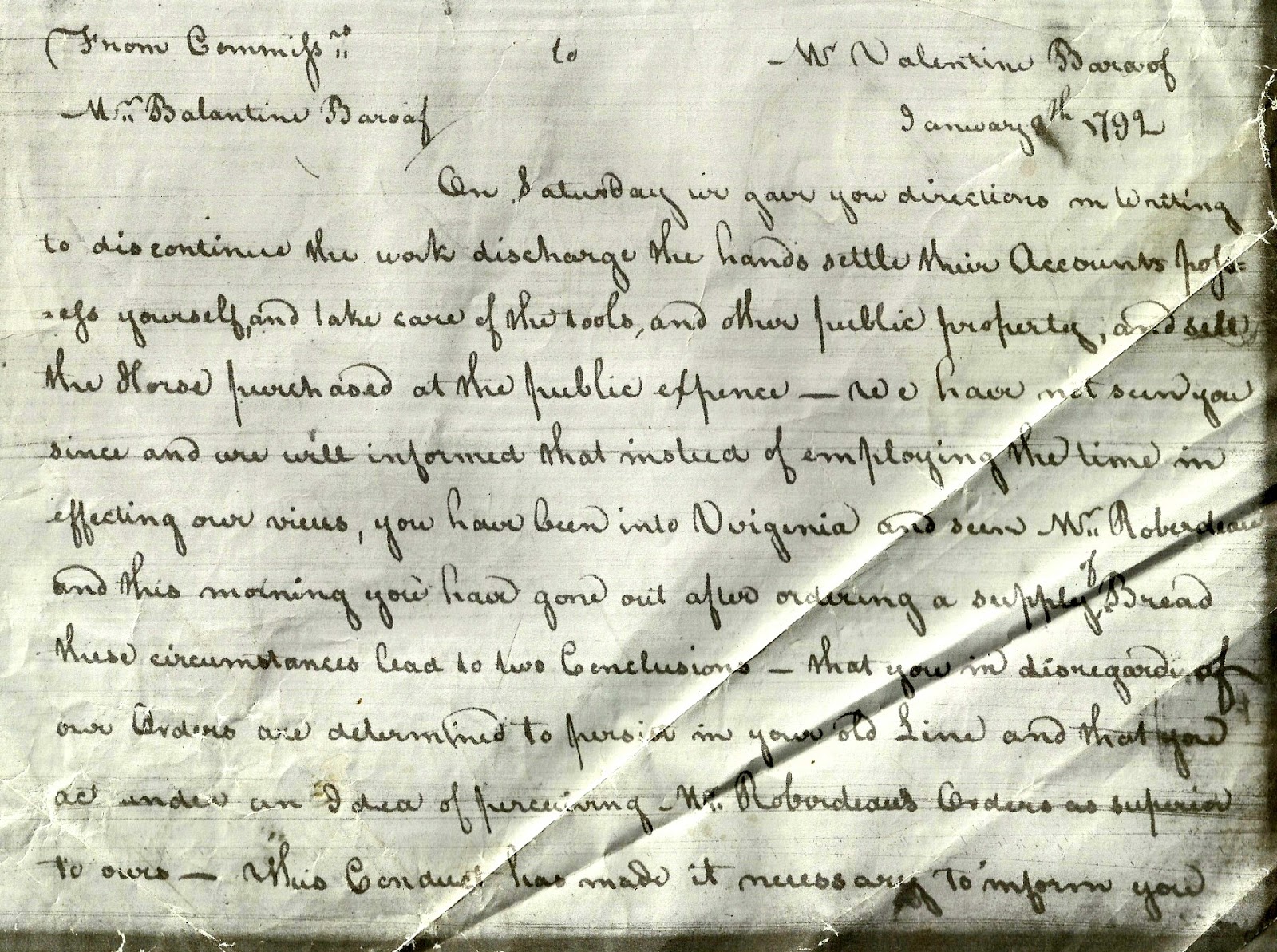
In September 1791 the commissioners authorize L'Enfant and Ellicott to hire 150 laborers. They managed to hired 75. There is no evidence that any of them were hired slaves. After those laborers were fired, the commissioners resolved to hire slave laborers. They would not make such a pointed resolution if they had already hired slaves. In the first document below, a letter to L'Enfant and Ellicott, the commissioners express their disappointment that 150 laborers were not hired. They worried that more "hands" were needed to get the city ready for an auction of lots in a few weeks. All three commissioners were slave owners, but they don't suggest the hiring of slaves. They suggest offering higher wages, "an advance price for a fortnight or a month."

The commissioners fired all the workers hired in early January. Letters generated by that, also copied below, give more evidence that none of the hands hired were slaves,


The commissioners January 9, 1792, letter to Valentine Boraff, the commissary  hired to feed the workers, clearly shows that the workers L'Enfant hired were not slaves. In the first sentence of the letter below the commissioners note that they had ordered Boraff to "discharge the hands settle their Accounts...." The commissioners never set up an account with a slave. All the money earned by all of the slaves that they subsequently hired went to the slave's master.

Below that letter I add two letters from Boraff as he tried to adjust to his dismissal and get reimbursed for money he had advanced for the work including $30 for a horse he bought because he had to ride so often to Georgetown to get supplies. He worked for 179 days for $1 a day. He wrote the second letter to Roberdeau who after being fired conspired with several Georgetown speculators to continue to pay the fired laborers. Roberdeau left the city leaving Boraff to deal with the laborers when he could not pay them. This is another indication that none of the laborers were slaves since once dismissed their  masters would be obliged to care for them.

Finally there is a receipt reimbursing Roberdeau  for feeding the fired laborers until January 21. I think Roberdeau reimbursed Boraff back in 1792.


Wednesday, April 22, 2015

Missing records on slave hire?

"We can only get a general idea of what they did."
Quote from Slave Labor in the Capital, page 16

In early 1795, the commissioners listed the duties of their newly hired clerk/paymaster. They were most particular in tying payments to payrolls certified by superintendents. As I read the long document, I expected to find at least a recognition of hired slaves, how they were managed and how their masters were to be paid. I didn't. The document does not use the word "slave," only "laborer." The 13th rule listed in the document says: "That the Superintendent of the Laborers employed by the year shall make quarterly returns at least of their numbers and the places where employed, of the supplies furnished, the supplies on hand and where stored." A scan of that and other "rules" are at the end of this post.

I found no such records. But evidently the "returns" were made. For example, the commissioners' proceedings for May 2, 1797, reports "Return of Provisions and the number of laborers at the Capitol and President's house at the commencement of the present month received from Samuel Smallwood and Isaac Nesmith."


Samuel Smallwood complained about how difficult it was to keep track of laborers: "I have a great deal of trouble making out return of labs and paying the monthly labs...." http://capitalslaves.blogspot.com/2015/03/more-than-farm-overseer-smallwoods.html

There seemed to be a grasp of how much it cost to feed the laborers. In one of his estimates of expenses Hoban used the figure 12 cents a day to feed each of the hired "Negroes." http://capitalslaves.blogspot.com/2015/01/hobans-estimates-of-expenses-and-use-of.html

If their written reports were lost, how important is that lost information? Payrolls gave a very particular idea of where all the laborers worked. Here is a link to one for May 1797: http://archivepayrolls.blogspot.com/2015/01/payroll-for-laborers-may-1797.html

However, payrolls kept track of monthly wages. Slaves hired by the year would have been noted on the quarterly "returns" that seem to be missing or at least they weren't given me when I did research at the National Archives. Most masters were paid quarterly so I think by going more carefully through all the accounts kept by the commissioners someone can get a good picture of the number of slaves hired.

But a complete "return" of where the slaves worked and any possible variation in their monotonous diet would be interesting. Also the returns might show the employment of white laborers hired by the year differed from that of hired slaves.

However,  we should remember that the whole point of hiring slave laborers was to suppress wages and the "demands" of free workers. The commissioners did not have a management team collecting data so that workers could be employed more efficiently, let alone trying to pinpoint individual laborers showing exceptional skill. As long as laborers, black or white, were simply called laborers, there could be no suggestion that they had skills that deserved extra pay. So we have no evidence that a certain laborer always worked the cranes or mixed mortar. I think the commissioners only kept a close eye on the expense of feeding the laborers.


Sunday, April 5, 2015

Public carts probably manned by hired slaves

"...the commissioners still maintained what were known as 'public carts,'...."

Quote from Slave Labor in the Capital, page 83

Well, I think they did. I found no payrolls for carters but I think that means that laborers manned the carts probably to do both the heavy lifting and drive the carts. This letter from Lewis Deblois written in 1796 suggests that. He asks to commissioners to send an overseer and a "public cart" to retrieve some stolen lumber. There are payrolls for overseers and they were invariably called overseers of the laborers.

This letter is also interesting because it accuses Alexander Leslie, an associate of Daniel Carroll of Duddington, the main land owner on Capitol Hill, of the thefts. Evidently at that time there was no knee jerk racist reaction of blaming blacks for any thefts.

The letter also shows that despite the many slaves in the area getting work done was not as simple as whipping them into line.

In the 1800 census Daniel Carroll is listed as owning 25 slaves. The bridges to make Pennsylvania Avenue east of the Capitol passable were made of logs that came from Carroll. We can easily imagine Carroll's slaves cutting, preparing and delivering the logs. Or can we? Deblois writes "but for the want of 150 dollars (which would complete the bridges) the cost of the logs with the labor of hauling and laying will shortly be lost." That suggests that the project stopped once there was no money to pay workers evidently mostly, if not all, common laborers. The commissioners could not spare theirs nor could Carroll spare his without more money.

Deblois owned a store served by the avenue and the letter was probably as much to remind the commissioners to finish the project as it was to save the logs. However, there was a remarkable degree of distrust between land owners and the commissioners and between fellow land owners. I hope my book Through a Fiery Trial makes that apparent. The number 59 written on top of the photocopy of the letter I scanned refers to the chapter in an early draft of that book that used the info in Deblois's letter. The snarling between land owners is actually developed in chapter 60. You can get a taste of William Tunnicliff's rivalry with Deblois in this blog post.


Friday, March 20, 2015

Thomas Johnson, the commissioner who pushed for hiring slaves

"Knowing that Johnson had hired slaves to work for the Potomac Company, Washington and Jefferson must have suspected he would persuade his fellow commissioners to hire them too and that it was pointless to comment."

Quote from Slave Labor in the Capital, pages 48-49

In 1792 and 1793, President Washington and Secretary of State Jefferson periodically urged the commissioners to hire workers from Europe or New England. Yet they never wrote about the workers the commissioners did hire. There are no mentions of the hired slaves working on the Capitol and White House in their letters to the commissioners or between themselves. I don't think we can simply say that it goes without saying that they knew slaves would be used. The commissioners resolved to hire slaves over a year after development of the city began. They fired white workers before hiring slaves.

I am certain that Washington or Jefferson did not instruct them to do that. Both men, who had been frequently away from their plantations, thought slavery was a problem, both for the nation and personally for themselves as they managed their personal affairs. But the commissioners they appointed thought of slavery as a solution to the problems they faced. Certainly Washington and Jefferson knew that Commissioner Thomas Johnson felt that way. They also knew that with his forceful personality he would dominate the other two commissioners.

In this blog I am trying to share documents that help describe work in Washington in the 1790s highlighting the work of slaves when I can. Thanks to Commissioner Johnson being the only man in the office one day in 1794, three orders of the commissioners were written out by him in his difficult to read scrawl and authorized with his initials.

By using "Negro" rather than "slave" whenever they wrote about the slaves they hired, the commissioners put a better light on their policy. It was better form not use the word slave in the land of the free. As the third order in the scan below shows, Commissioners Johnson was matter-of-fact. He dashed off an ad for Baltimore and Easton, Maryland, newspapers soliciting "slaves." (I've never had time to search for copies this ad in newspapers so I don't know if "slaves" made it into print.)

With publication of Slave Labor in the Capital, I took my five part essay on the use of slaves on the public buildings off the web. Below the two scans of Johnson's orders, I've copied my considered opinion of Johnson as a commissioner that is in that web essay.


To be sure, Johnson thought the policy of hiring slaves was bowing to necessity. Due to slow sales of city lots and the inability to get a loan on city lots, the commissioners did not have money to spare and needed to get laborers as cheaply as possible. But for Johnson personally there may have been more involved. As we reconstruct the lives of the men in the Founders' generation we tend to see them as men of native talent confronting the novel challenges of creating a new nation. The c.v. of Thomas Johnson seems to show just this, as he combined high political office, and brief military service, during years of revolution. Then in a period of nation building he was a lawyer, administrator, entrepreneur, and while serving as commissioner, at the time a non paying job, Washington appointed him a justice of the Supreme Court, and wanted to make him Secretary of State.

In the flux of the life of someone so evidently prized as a problem solver, it is easy to overlook his own overriding sense of entitlement. As became clear shortly before he left the commission, Johnson intended to profit from the development of the federal city. While still a commissioner he advertised the sale of almost all his property in and around Frederick, Maryland, including "several good negro foremen." He explained to the President that he wanted "to avail myself of the moment which I saw and has almost past away to benefit myself by the rise of the city to which a long friendship for Potomack and every exertion in my power in its favor fairly intitle me." (Johnson to Washington, 23 Dec 1793) In a March 13, 1795 letter, his successor as commissioner, Gustavus Scott, hoped that a favorable opinion from Attorney General against Johnson's quest to buy water lots in the city would "have the happy effect of quieting the appetite of the little man." (Thornton Papers) This suggests a motive for his antipathy to L'Enfant who not only had the original proprietors in the city worked up in a white heat of expectation, but was amassing a work force with earth moving morale even in the dead of winter. The dismissal of L'Enfant cooled the proprietors who recognized that losing someone tied so closely to the venture lessened, for the moment at least, the value of their land. Hiring slaves chilled the expectations of workers. In this cool environment, the city would progress slowly, which allowed Johnson to bide his time until he sensed the time was right to buy city property.  

The right moment for Johnson came in late 1793 after he negotiated an extensive sale of 6,000 city lots to the Boston speculator James Greenleaf. Johnson was persuaded to sell lots so cheaply because Greenleaf also offered to raise a loan for the commissioners, pay for the lots in seven equal annual installments which would pay for work on the Capitol and President's house, build 140 brick houses in the city and, in private negotiations, to buy the private lands Johnson had offered for sale. (See my Tracking the Speculators: http://www.geocities.com/bobarnebeck/speculators.html)

In tracing the genesis of the use of slaves in the city, it is clear to me that their employment was not a matter of policy initiated or even explicitly approved at the highest level, that is, by Washington and Jefferson. Our current conception of the nation's founders is one of men of grace, genius and gravitas hemmed in by the rude conditions of the times. We chaff at the idea that they could be manipulated by underlings. While Washington supported the commissioners and thought so much of Johnson that he asked him to take complete charge of the city, he never explicitly commented on the use of slaves. One might argue that their use of slaves was reassuring to a slave owner like the president, and, because of that, Johnson remained in Washington's good graces as others not interested in slaves, like L'Enfant and Ellicott, fell from favor. However, in his will Washington tried to free his slaves, which suggests that he harbored some doubts about the institution. In their book George Washington's Mount Vernon: At Home in Revolutionary America, (Oxford U Press 1998) Robert F. Dalzell, Jr. and Lee Baldwin Dalzell note Washington's disgust at his own slaves. On February 16, 1794, he wrote from Philadelphia to his overseer William Pearce about them: "It appears to me, that to make even a chicken coop, would employ them all week; buildings that are run up here in two or three days (with not more hands) employ them a month or more." Combine that attitude with his constantly urging the commissioners to get emigrant workers, and one has to think that a propensity to employ slaves did not endear a man to Washington. 

Saturday, February 14, 2015

Free laborers and slaves hired by the month

The laborers hired by the year, principally slaves, were evidently not kept on payrolls. Their wage did not vary unless they were absent for over a week. As these 1796 payrolls for overseers and laborers show, overseers and free laborers were on payrolls and during the building season monthly hires, usually more free laborers than slaves, were added to the payrolls.

The March 1796 payroll lists three overseers, including John S. Slye, who was hired by the commissioners as a reward for bringing 30 hired slaves to the city. Obviously those slaves, paid by the year, are not on this monthly payroll. One of the two laborers on the payroll, Jeremiah Holland, was, I think, the laborer referred to in a 1795 note as "Jerry the black man." 


The April payroll is as spare as the one in March and Slye is not on it. My guess is that he left or was fired.


I copied the July and August 1796 payrolls for overseers and laborers which shows how the number of laborers swelled. Also two new overseers are listed: William White and Samuel Smallwood. The July payroll shows that laborers got a raise in the middle of the month from 60 Maryland shillings a month to 75. However in the spring of 1797 they would again make 60 shillings a month so the raise was probably an inducement to continue working during the hot months.

These payrolls do not segregate the free laborers paid by the month from the slaves. Although members of the same family did work together, usually men with the same second name listed together were slaves and that the last name they shared is the last name of the master. Unfortuntely,  many of the payrolls were bigger than the photocopy machine at the Archives so I did not always include the signature of the person who received the monthly wages.

In my book I list hired slaves, masters, black laborers and white laborers so there you can find my ideas on the status of all the men on these payrolls. Below the 1796 payrolls, I show a scanned photocopy of a May 1797 payroll showing how a master or his agent signed for the receipt of his slaves' wages. The two men listed with Burnes as the last name were slaves of James Burnes.